• Home
  • Biografia | Biography | Biographie | Biografie
  • Mostre | Exhibitions | Expositions | Ausstellungen
  • Contatti | Contacts | Kontakte
  • Autentiche e autorizzazioni | Authentication and authorizations

LUCIA MARCUCCI

LUCIA MARCUCCI

Archivi tag: Zasha Colah

Lucia Marcucci. L’OFFESA [Curatorial text/Kuratorischer Text: Francesca Verga]

11 domenica Giu 2023

Posted by Lucia Marcucci in Eventi

≈ Lascia un commento

Tag

Ar/Ge Kunst, Arte Contemporanea, Contemporary Art, Francesca Verga, Lucia Marcucci, Museion, Poesia Visiva, Visual Poetry, Zasha Colah

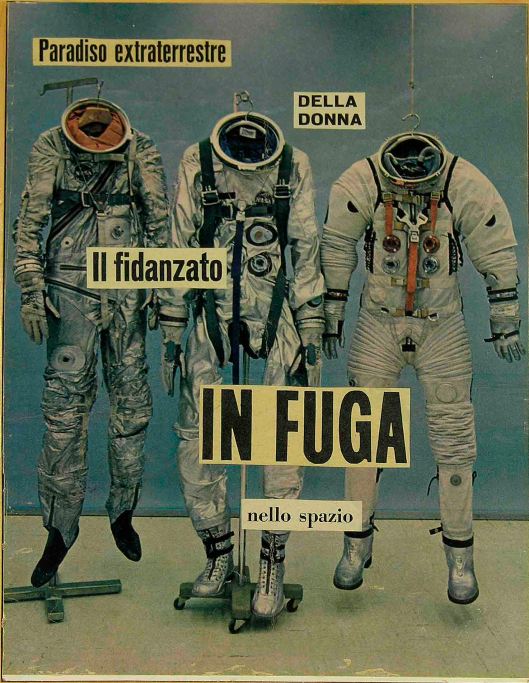
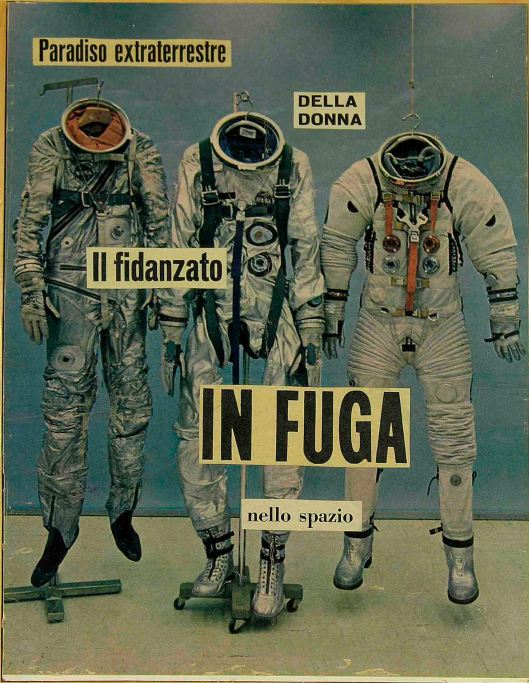
It was 1964 when artist Lucia Marcucci (Florence, 1933) created the work Il fidanzato in fuga: a collage on cardboard depicting three freestanding spacesuits, as if attached to clothes hangers, bodyless. The collage reads: “Paradiso extraterrestre della donna, il fidanzato in fuga nello spazio” (“A woman’s extra-terrestrial paradise: a fiance on the run in outerspace”). An ironic and provocatory phrase, it denounces the condition of contemporary women and showcases their need for freedom and transgression in a society obsessed with scientific and technological progress during the Cold War period, in constant ascent towards the ‘conquest’ of space. The following year, as part of Gruppo ’70, with Eugenio Miccini, Lamberto Pignotti and Antonio Bueno, Lucia Marcucci put up posters and then ripped them, including the poster L’Offesa, during their poetry shows Poesie e no (1964–1967). These were a series of multimedia happenings featuring poems as well as non-literary material. The events, particularly Poesie and no 3 (1965), drew on a range of languages—poetry readings, newspaper columns, slogans, extracts from novels, experimental film screenings and other ephemeral and volatile actions—to the music of Giuseppe Chiari. It was all put together in a Cubist-style collage of words and recitals, clips, scraps and offcuts, moving away from the linear construction of content.
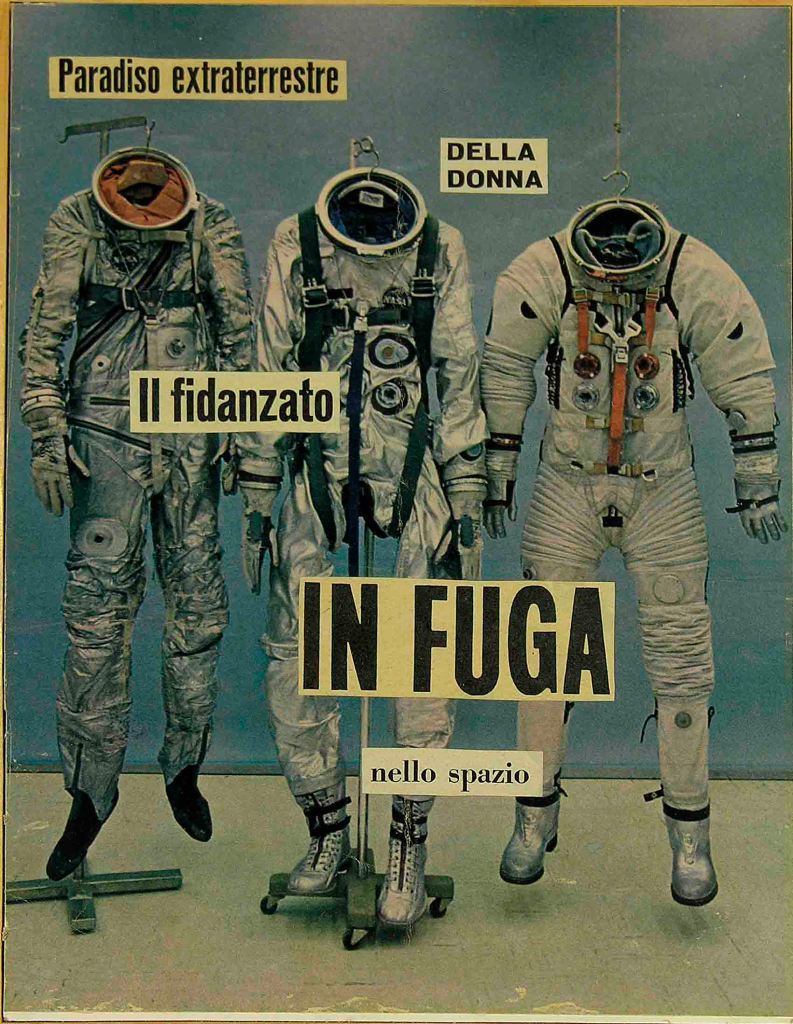
Lucia Marcucci – Il fidanzato in fuga (1964)

Dorothy D. Lee (1905–1975) wrote about non-lineal thinking in the text ‘Lineal and Nonlineal Codifications of Reality’ (1950), which Marcucci would often quote.¹ In this text, the American anthropologist took the example of the interruption of the ‘thread of the discourse’ for people living in the Trobriand Islands, where it is accepted as something non-invasive in a culture characterised by the absence of linear continuity. Instead, the Western mindset that Marcucci challenges and criticises lulls itself into believing the line is the true path, that linear planning means success, increasingly thirsty for rectilinear progress. In this capitalist conception, there is no room left for failure as an interruption of linearly conceived movement. But is it so important to read reality through the presence of the line and reach a point on the horizon at a precise moment?

Lucia Marcucci seems to ask herself the same questions as Dorothy D. Lee, rooting her works along a pathway that is not a connection between two points but one that moves around, a source of continuous influences and obstacles, independent tracks, setbacks, failures and contestations. Her collages, like her works of cine-poetry, the non-linear montage technique—in particular Volerà nel ’70 (1965) and Pugni, Pistole e Baci (1966) —are reminiscent of many of Pedro Almodóvar’s films: a non-linear composition that steeps past and present in the narrative context. Dorothy D. Lee also referred to Trobriand verbs as timeless.² In these forms of conceiving, history and reality are always present, lending meaning to present actions. And this is how Marcucci plays it: rummaging through and drawing on her own past and that which surrounds us in the languages of mass communication, immersing us in a critical rereading of the present.

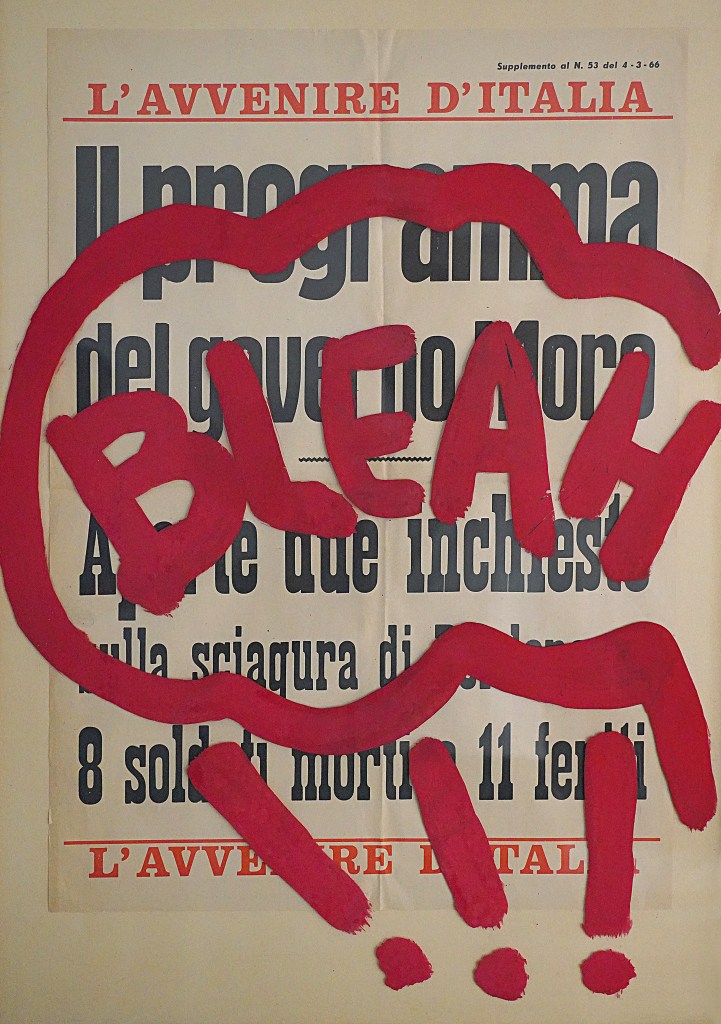
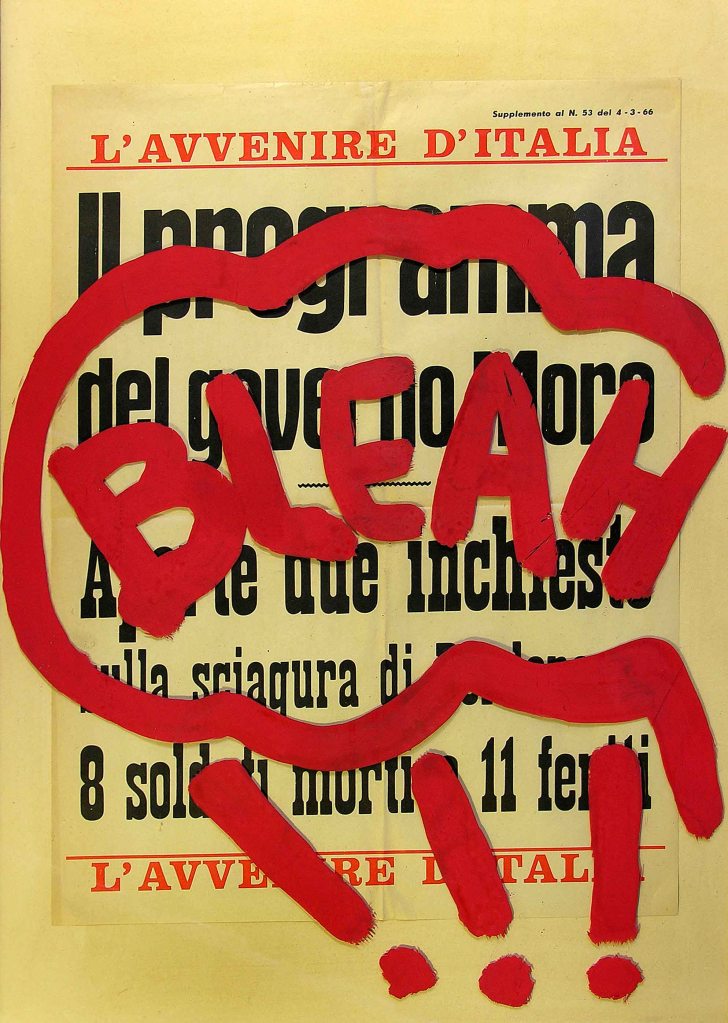
Lucia Marcucci stood out by virtue of her table-turning of the poetic word, which became part of the feminist struggles in the 1960s. What the artist defines as “returning the lexicon to the sender” means exploiting language with irony to pursue a critical redemption of stereotypes, of gender and the assumptions regulating representation of the female body, and of the forms and habits imposed upon it by capitalist society. The artist thus unveiled the nonsense and ideological emptiness underpinning mass communication, especially on topical issues. Bleah!!! (1967), a work on painted glass with a newspaper headline board, seemed to provide the only plausible answer at the time: one of outright dissent.

In 1965, Lamberto Pignotti published an anthology of visual poetry in the series Il Dissenso (published by Sampietro, Bologna). It consisted of four volumes featuring fragments of visual poetry, to be shuffled around like a pack of cards. From this moment on, the book form is extruded, exploding into the surrounding space and bringing the word to life beyond its container. There is no longer the word on paper but, like in Lucia Marcucci’s work, the word is brought back to the streets, squares and venues where civic relations might be established, and bodies along with them. But what role did (and does) the body—its perception, gesture and language—play within poetic struggle?

On the occasion of the artist’s ninetieth birthday, the exhibition L’Offesa at Ar/Ge Kunst (9 June – 29 July 2023), curated by Francesca Verga and Zasha Colah, retraces some of the artist’s works from the 1960s up to the 1990s on loan from the Lucia Marcucci Archive and the Frittelli Arte Contemporanea Gallery. The exhibition re-examines how speech, advertising, media and paper were questioned in the 1960s and 1970s through militant practices intensifying verbal and bodily presence. For it is through both body and word that the poetic worth of the stroke and its imaginative value may be rediscovered.
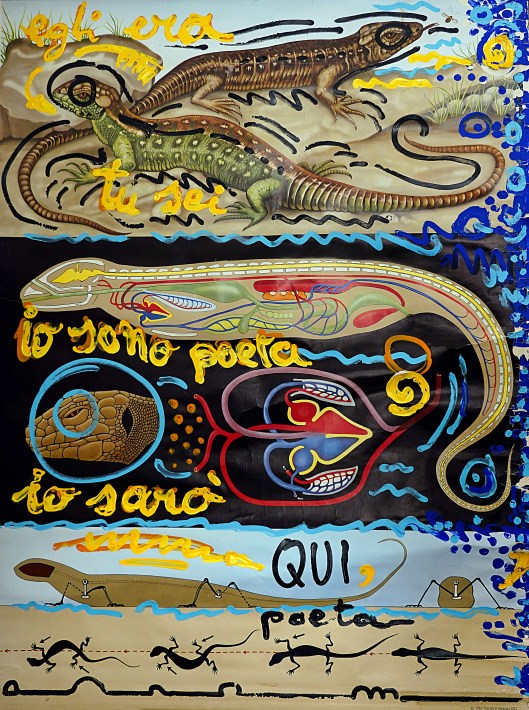
Lucia Marcucci – Io sarò, qui, poeta (1995)

On display are a number of works created from the 1960s onwards on the verbo-visual side of technological poetry, auditory poetry, cine-poetry (such as the works Volerà nel ’70, 1965, and poesia auditiva, 1970), collages on cardboard and non-linear montage techniques. Together with these, the acrylics on prints and posters, such as Sigh (1968), Waah! (1968) and Boh, eh (1970), constitute a pivotal moment in the display of political and social dissent in poetic terms. Furthermore, there is also a return to the manual skills of the 1970s: the imprints of the artist’s body on emulsified canvases, along with the imprints, signs and words on her didactic tables produced in the 1990s reconfirm the artist’s interest in visceral dissections of the body and the link between body and word, continuing to toy with scientific contexts.

The exhibition L’Offesa at Ar/Ge Kunst also develops a critical reflection on the contemporary sphere by placing some of Lucia Marcucci’s works in dialogue with the voices of other artists. An audio-visual and installation work by the artist Wissal Houbabi brings dissent and struggles in today’s society in dialogue with Marcucci’s politics; Elena Biserna with the scores of The Resounding Flâneuse and the Feminist Steps walk (9–10 June 2023, Bolzano), explores the (auditory) experiences of the nocturnal city from a gendered perspective. And as part of Bolzano Danza, the dancer Annamaria Ajmone and the musician Laura Agnusdei present Bleah!!! (20–21 July 2023, Parco dei Cappuccini, Bolzano): a performance that blends gesture and sound in assemblages that are a table-turning of notions of the temporal, spatial and authorial.

The show at Ar/Ge Kunst is further complemented by the exhibition Lucia Marcucci. Poesie e no at Museion, Bolzano, curated by Frida Carazzato. The two solo shows revolve around the experience that gave rise to the Poesie e no happenings. The collage of visual and linguistic signs that characterises this series of performances allows the two institutions to explore two complementary strands of Marcucci’s work: on the one hand the investigation of language starting with the critique of consumer society that finds space in Museion, and on the other, the presence of the word and body in social militancy, through the interpretation further manifested by other contemporary voices in the Ar/Ge Kunst show.

Curatorial text by Francesca Verga and Zasha Colah, Ar/Ge Kunst, 2023.

Translation from Italian to English: Ben Bazalgette, 2023.

¹ Lee, Dorothy, „Lineal and Nonlineal Codifications of Reality“, in: Symbolic Anthropology: A Reader in the Study of Symbols and Meanings, hg. von Dolgin, Janet L., Kemnitzer, David S. und Schneider, David M., New York 1977, S. 151–164.

² Dorothy D. Lee, „Being and Value in a Primitive Culture“, in: dies., Freedom and Culture, Englewood Cliffs 1959, S. 89–104; „Codifications of Reality: Lineal and Nonlineal“, in: ebd. S. 105–120.

© All rights reserved

…

Es ist das Jahr 1964, und die Künstlerin Lucia Marcucci (*1933 in Florenz) gestaltet auf Karton die Collage Il fidanzato in fuga. Darauf dargestellt sind drei aufrecht stehende Raumanzüge, die aufgehängt sind wie Marionetten, aber ohne Körper. Collagiert ist zu lesen: „Das außerirdische Paradies der Frau, der Verlobte auf der Flucht ins All.“ Ein so ironischer wie provokanter Satz, der die Befindlichkeit der zeitgenössischen Frau spiegelt und ihren Anspruch auf Freiheit und Überschreitung in einer Gesellschaft betont, die besessen war von Wissenschaft, Technologie und Fortschritt und sich zur damaligen Zeit in einem kontinuierlichen Aufstieg hin zur „Eroberung“ des Weltraums wähnte. Im darauffolgenden Jahr hängte Lucia Marcucci – als Teil des Gruppo ’70 – zusammen mit Eugenio Miccini, Lamberto Pignotti und Antonio Bueno Plakate auf, nur um sie anschließend zu zerreißen, so geschehen etwa mit der Arbeit L’Offesa im Zuge ihrer gemeinsam aufgeführten Poesie-Spektakel Poesie e no (1964–1967). Dabei handelte es sich um eine Reihe multimedialer Happenings unter Einbeziehung von Gedichten sowie Matrixmaterialien außerliterarischer Herkunft. Im Rahmen dieser Veranstaltungen, allen voran Poesie e no 3 (1965), verbanden sich verschiedene Formen von Sprache: das Vorlesen von Gedichten, Zeitungskolumnen, Slogans und Romanauszügen mit der Vorführung experimenteller Filme und weiteren ebenso flüchtigen wie vergänglichen Aktionen zur Musikbegleitung Giuseppe Chiaris. Dies alles fügte sich zu einer aus Wörtern und Rezitationen, Ausschnitten, Fragmenten, Schnipseln und Überbleibseln gefügten Collage, die sich von einer linearen Konstruktion der Inhalte entfernte.
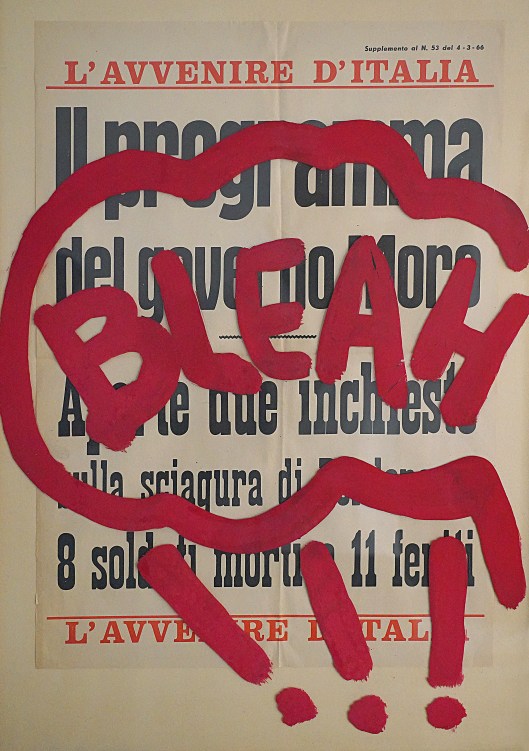
Lucia Marcucci – Bleah!!! (1967)

Über das nicht-lineare Denken hatte sich bereits Dorothy D. Lee (1905–1975) in dem von Marcucci gern zitierten Text „Lineare und nicht-lineare Kodifizierungen der Realität“ (1977) geäußert.¹ Darin führte die amerikanische Anthropologin die Bewohner*innen der Trobriand-Inseln als Beispiel für eine Kultur an, die durch das Fehlen von linearer Kontinuität geprägt ist und somit eine Unterbrechung des „Diskursfadens“ als nicht störend empfindet. Das von Marcucci infrage gestellte und kritisierte westliche Denken hingegen gibt sich der Illusion hin, dass die Linie unser Weg wäre und lineare Planung der Weg zum Erfolg, angetrieben von einem immer unersättlicheren Bedürfnis nach geradlinigem Fortschritt. In dieser kapitalistischen Vorstellungswelt bleibt kein Raum für das Scheitern, für die Unterbrechung einer als linear gedachten Bewegung. Ist es aber tatsächlich so wichtig, die Wirklichkeit über die Gegenwart der Linie zu lesen und zu einer bestimmten Zeit an einem bestimmten Ort am Horizont anzukommen?

Lucia Marcucci scheint sich die gleichen Fragen zu stellen wie Dorothy D. Lee, spürt in ihren Werken einer Spur nach, die keine Verbindung zwischen zwei Punkten darstellt, sondern in Bewegung ist, eine Quelle immer neuer Einflüsse sowie Ursache von Flecken, von eigenen Wegfindungen, Rückschritten, Fehlschlägen und Anfechtungen. Ihre Collagen erinnern ebenso wie ihre kinopoetischen Werke – vor allem Volerà nel ’70 (1965) und Pugni, Pistole e Baci (1966) – vielfach an die Filme Pedro Almodóvars, verknüpfen Vergangenes und Gegenwärtiges in einer Erzählung, die ohne Linearität auskommt. Schon Dorothy D. Lee hatte die trobriandischen Verben als zeitlos bezeichnet.² Folgt man diesen Vorstellungen, so sind Geschichte und Wirklichkeit stets gegenwärtig und geben unserem aktuellen Handeln einen Sinn ein. Und damit spielt Marcucci: Sie durchstöbert die eigene Vergangenheit, schneidet sich durch das, was uns die Sprachformen der Massenkommunikation zur Verfügung stellen, und lässt uns in eine kritische neue Lesart der Gegenwart eintauchen.

Ihr Werk zeichnet sich durch eine Umkehrung des poetischen Wortes aus, die auch Eingang in die feministischen Kämpfe der 1960er-Jahren fand. Wenn die Künstlerin davon spricht, „das Lexikon an den Absender zurückzusenden“, so bedeutet das, über einen ironischen und kritischen Gebrauch von Sprache eine Befreiung von Geschlechterstereotypen, von Annahmen über die Darstellung des weiblichen Körpers ebenso wie von aufoktroyierten Praktiken und Gewohnheiten der kapitalistischen Gesellschaft zu erreichen. Gerade in Bezug auf aktuelle Themen entlarvt Marcucci die sich hinter der Massenkommunikation auftuende Unsinnigkeit und ideologische Leere. Die Arbeit Bleah!!! (1967), bestehend aus bemaltem Glas und Zeitungsreklame, schien zur damaligen Zeit die einzig plausible Antwort zu geben: Dissens.

1965 veröffentlichte Lamberto Pignotti einen Sammelband visueller Poesie, der in der Reihe „Il Dissenso“ (Sampietro, Bologna) erschien. Die vier Bände beinhalten Fragmente visueller Poesie, die sich ähnlich wie Spielkarten mischen lassen. Ab diesem Moment dehnt sich das Buch aus, explodiert in den umgebenden Raum und lässt das Wort außerhalb seines Behälters lebendig werden. Somit steht das Wort nicht mehr nur auf dem Papier, sondern wird – wie auch im Werk Lucia Marcuccis – wieder auf Straßen und Plätze, in Leben und Orte gebracht, an denen Zivilbürgerschaft stattfindet, und mit ihr der Körper. Welche Rolle aber spielten (und spielen) der Körper und seine Wahrnehmung, die Geste und die Sprache im poetischen Kampf?

Anlässlich des 90. Geburtstags Lucia Marcuccis zeigt die Ar/Ge Kunst in der Ausstellung L’Offesa (9. Juni – 29. Juli 2023) verschiedene Werke der Künstlerin aus den 1960er- bis 1990er-Jahren, die von ihrem Archiv sowie der Galerie Frittelli Arte Contemporanea (Florenz) als Leihgaben zu Verfügung gestellt wurden. Die von Francesca Verga und Zasha Colah kuratierte Schau führt vor Augen, wie Sprache, Werbung, Medien und Papier in den 1960er- und 1970er-Jahren von einer militanten Praxis auf den Prüfstand gestellt wurden, die auf verbale und physische Gegenwart setzte. Anhand von Körper und Wort entdeckte sie die poetische Gültigkeit des Zeichens und seinen imaginativen Wert neu.
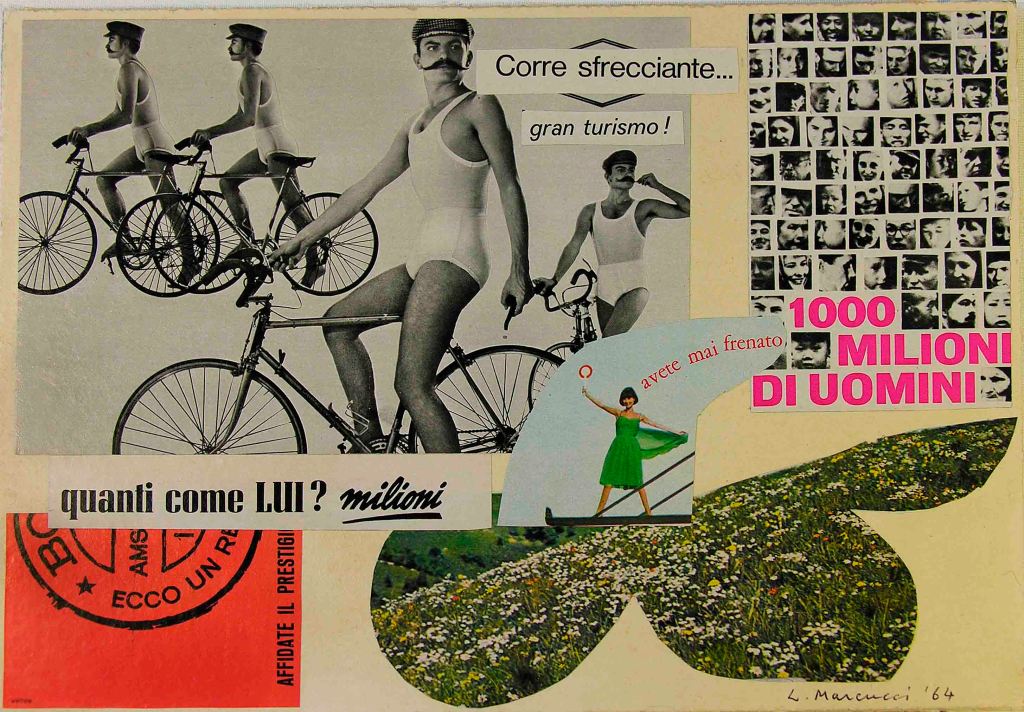
Lucia Marcucci – Milioni (1964)

Gezeigt werden ab den 1960er-Jahren entstandene verbo-visueller Werke der technologischen und auditiven Poesie, Kinopoesien mit nicht-linearen Montagetechniken (etwa die Arbeiten Volerà nel ’70 von 1965 und Poesia auditiva von 1970) sowie Collagen auf Karton. Daneben bieten auch die Acrylübermalungen von Reklame sowie Plakate wie Sigh (1968), Waah! (1968), Boh, eh (1970) kardinale Beispiele für die Formulierung politischen und gesellschaftlichen Dissenses in einer poetischen Tonart. Ebenfalls thematisiert wird die Rückbesinnung der 1970er-Jahre auf eine manuell geprägte Herangehensweise, etwa in den eigenen Körperabdrücken der Künstlerin auf emulgierten Leinwänden. Auch die Gesten, Zeichen und Wörter auf Schautafeln der 1990er-Jahre bestätigen erneut Marcuccis Interesse an viszeralen Bereichen des Körpers und seiner Verbindung zum Wort sowie den spielerischen Umgang der Künstlerin mit wissenschaftlichen Kontexten.

Darüber hinaus unternimmt die Ausstellung L’Offesa eine kritische Reflexion aus zeitgenössischer Perspektive, indem sie einige Werke Lucia Marcuccis in einen Dialog mit den Stimmen anderer Künstler*innen stellt. So bringt etwa die Künstlerin Wissal Houbabi eine audiovisuelle Installation in den Raum des Dissenses und der antirassistischen Kämpfe unserer heutigen Gesellschaft ein; Elena Biserna erkundet mithilfe der Partituren The Resounding Flâneuse und dem Spaziergang Feminist Steps (9./10. Juni 2023, Bozen) die (Hör-)Erfahrungen der nächtlichen Stadt aus einer geschlechtsbezogenen Perspektive; und im Rahmen von Bolzano Danza zeigen die Tänzerin Annamaria Ajmone und die Musikerin Laura Agnusdei die Geste und Klang verbindende Partitur Bleah!!! (20./21. Juli 2023, Kapuzinerpark, Bozen), die mit Assemblagen und dem Durchbrechen zeitlicher, räumlicher wie auktorialer Zusammenhänge arbeitet.

Die Ausstellung in der Ar/Ge Kunst wird ergänzt durch die von Frida Carazzato kuratierte Schau Lucia Marcucci. Poesie e no im Museion in Bozen. Beide Einzelpräsentationen kreisen um Erfahrungen, die zur Entstehung des Happenings Poesie e no geführt haben. Die mehrfach aufgeführte Performance zeichnet sich durch eine collageartige Nebeneinanderstellung visueller und sprachlicher Zeichen aus und wird zum Anlass, um in beiden Einrichtungen jeweils komplementäre Stränge von Marcuccis Œuvre zu beleuchten: So findet die von einer Kritik an der Konsumgesellschaft ausgehende Untersuchung von Sprache ihren Raum im Museion, während die Gegenwart von Wort und Körper im Aktivismus eine Re-Lektüre auch durch zeitgenössische Stimmen in der Ar/Ge Kunst erfährt.

Kuratorischer Text, Francesca Verga und Zasha Colah, Ar/Ge Kunst, 2023.

übersetzt von Ursula Fethke

¹ Lee, Dorothy, „Lineal and Nonlineal Codifications of Reality“, in: Symbolic Anthropology: A Reader in the Study of Symbols and Meanings, hg. von Dolgin, Janet L., Kemnitzer, David S. und Schneider, David M., New York 1977, S. 151–164.

² Dorothy D. Lee, „Being and Value in a Primitive Culture“, in: dies., Freedom and Culture, Englewood Cliffs 1959, S. 89–104; „Codifications of Reality: Lineal and Nonlineal“, in: ebd. S. 105–120.

© Alle Rechte vorbehalten
Lucia Marcucci. L’OFFESA [testo curatoriale di Francesca Verga]

10 sabato Giu 2023

Posted by Lucia Marcucci in Eventi

≈ Lascia un commento

Tag

Antonio Bueno, Ar/Ge Kunst, Arte Contemporanea, Contemporary Art, Dorothy D. Lee, Eugenio Miccini, Francesca Verga, Frida Carazzato, Giuseppe Chiari, Gruppo '70, Lamberto Pignotti, Lucia Marcucci, Museion, Poesia Visiva, Poesie e no, Visual Poetry, Zasha Colah

È il 1964 e l’artista Lucia Marcucci (Firenze, 1933) crea il lavoro Il fidanzato in fuga, un collage su cartoncino che raffigura tre tute spaziali che si reggono in piedi da sole, come agganciate a dei manichini, senza corpo. Il collage recita: Paradiso extraterrestre della donna, il fidanzato in fuga nello spazio. Una frase ironica e provocatoria che denuncia la condizione della donna contemporanea e porta avanti la sua esigenza di libertà e trasgressione, all’interno di una società ossessionata dai progressi scientifici e tecnologici e a quel tempo in costante ascesa verso la “conquista” dello spazio. L’anno seguente, Lucia Marcucci, come parte del Gruppo ’70, con Eugenio Miccini, Lamberto Pignotti e Antonio Bueno, affigge manifesti per poi strapparli, come il manifesto L’Offesa, durante le loro poesie-spettacolo Poesie e no (1964-1967). Si tratta di una serie di happening multimediali contenenti poesie e materiali di matrice extra-letteraria. Questi eventi, in particolare Poesie e no 3 (1965), coinvolgevano diversi linguaggi: letture di poesie, rubriche giornalistiche, slogan, estratti di romanzi, proiezione di film sperimentali, e altre azioni effimere e volatili sotto le musiche di Giuseppe Chiari. Il tutto assemblato in un collage cubista di parole e recite, spezzoni, ritagli, scarti e rifiuti, che si allontana da una costruzione lineare dei contenuti.

Lucia Marcucci – Il fidanzato in fuga (1964)

Aveva scritto sul pensiero non lineare anche Dorothy D. Lee (1905-1975), all’interno del testo “Lineal and Nonlineal Codifications of Reality” (1950), che Marcucci amava citare¹. In questo testo, l’antropologa americana prendeva da esempio l’interruzione del “filo del discorso” per le persone che vivono nelle isole Trobriand, accettata come qualcosa di non disturbante in una cultura caratterizzata dall’assenza di una continuità lineare. Il pensiero occidentale che Marcucci contesta e critica si è invece illuso che la linea sia la strada, che la pianificazione lineare sia il successo, sempre più assetato di un progresso rettilineo. In questa concezione capitalistica non resta spazio per il fallimento, in quanto interruzione di un movimento concepito linearmente. Ma è così importante leggere la realtà attraverso la presenza della linea e arrivare in un punto all’orizzonte in un preciso momento?

Lucia Marcucci sembra porsi gli stessi quesiti di Dorothy D. Lee, immergendo le sue opere in una traccia che non è un collegamento tra due punti ma si muove, fonte di continue influenze e macchie, percorsi autonomi, indietreggiamenti, fallimenti e contestazioni. I suoi collage, così come i lavori di cinepoesia, la tecnica di montaggio non lineare, in particolare Volerà nel ’70 (1965) e Pugni, Pistole e Baci (1966), ricordano a molti i film di Pedro Almodóvar, una composizione non lineare che immerge passato e presente nella narrazione. Sempre Dorothy D. Lee aveva fatto riferimento ai verbi trobriandesi come atemporali². In queste concezioni, storia e realtà sono sempre presenti, dando senso alle azioni attuali. E così gioca Marcucci: tagliando e frugando nel proprio passato e in quello che è a nostra disposizione nei linguaggi della comunicazione di massa, immergendoci in una rilettura critica del presente.

Lucia Marcucci si è distinta per il rovesciamento della parola poetica, che è diventata parte delle lotte femministe negli anni Sessanta. Quello che l’artista definisce come “rispedire il lessico al mittente” significa portare avanti, attraverso l’ironia nel linguaggio, un riscatto critico sugli stereotipi, sul genere e gli assunti che regolavano la rappresentazione del corpo femminile, sulle forme e abitudini imposte dalla società capitalistica. L’artista ha svelato l’insensatezza e il vuoto ideologico che si cela dietro la comunicazione di massa, soprattutto sui temi di attualità. Bleah!!! (1967), opera in vetro dipinto e civetta di giornale, sembrava a quel tempo l’unica risposta plausibile: il dissenso.

Lucia Marcucci – Bleah!!! (1967)

Nel 1965 Lamberto Pignotti pubblica l’antologia di poesia visiva nella collana “Il Dissenso” (casa editrice Sampietro di Bologna). Si tratta di quattro volumi contenenti al loro interno frammenti di poesia visiva, da mescolare come un mazzo di carte. Da questo momento il libro si estroflette, esplode nello spazio circostante e fa vivere il verbo al di fuori del suo contenitore. Non c’è più la parola su carta ma, come nell’opera di Lucia Marcucci, si riporta la parola nelle strade, nelle piazze, nelle vie e nei luoghi dove si svolgeva la relazione civica, e con essa i corpi. Ma che ruolo aveva (e ha) il corpo, la sua percezione, il gesto e il linguaggio, all’interno della lotta poetica?

Per il novantesimo compleanno dell’artista, la mostra L’Offesa ad Ar/Ge Kunst (9 giugno – 30 luglio 2023), curata da Francesca Verga e Zasha Colah, ripercorre alcuni lavori dell’artista tra gli anni Sessanta e gli anni Novanta in prestito dall’Archivio Lucia Marcucci e la Galleria Frittelli Arte Contemporanea. La mostra ridiscute come la parola, la pubblicità, i media e la carta sono state messe in discussione negli anni Sessanta e Settanta attraverso una pratica militante che intensifica la presenza verbale e corporale. È attraverso il corpo e la parola che si riscopre la validità poetica del segno e la sua valenza immaginifica.

Vengono esposti alcuni lavori realizzati a partire dagli anni Sessanta sul versante verbo-visuale della poesia tecnologica, poesia auditiva, della cinepoesia (come le opere: Volerà nel ’70 del 1965 e poesia auditiva del 1970), collage su cartoncino e tecniche di montaggio non-lineari. Insieme a questi, gli acrilici su locandina e i manifesti, come Sigh (1968), Waah! (1968), Boh, eh (1970), costituiscono un punto cardine nel manifestare il dissenso politico e sociale in chiave poetica. Inoltre, si ripercorre il ritorno alla manualità degli anni Settanta, ne sono ad esempio le impronte del corpo dell’artista sulle tele emulsionate. Ma anche i getti, segni e parole sulle sue tavole didattiche realizzate negli anni Novanta riconfermano l’interesse dell’artista nei sezionamenti viscerali del corpo e la connessione tra questo e la parola, che continua a farsi gioco dei contesti scientifici.

Lucia Marcucci – Io sarò, qui, poeta (1995)

La mostra L’Offesa ad Ar/Ge Kunst sviluppa inoltre una riflessione critica sulla contemporaneità mettendo alcune opere di Lucia Marcucci in dialogo con le voci di altre artiste. L’artista Wissal Houbabi porta un lavoro audio visuale e installativo nello spazio del dissenso e delle lotte antirazziali dell’attuale società; Elena Biserna con le score The Resounding Flâneuse e la passeggiata Feminist Steps (9-10 giugno 2023, Bolzano), esplora le esperienze (uditive) della città notturna da una prospettiva di genere; all’interno di Bolzano Danza, la danzatrice Annamaria Ajmone e la musicista Laura Agnusdei presentano Bleah!!! (20-21 luglio 2023, Parco dei Cappuccini, Bolzano) una partitura che mescola gesto e suono lavorando su assemblaggi e ribaltamenti sul piano temporale, spaziale, autoriale.

La mostra ad Ar/Ge Kunst si completa con la mostra Lucia Marcucci. Poesie e no presso Museion, Bozen/Bolzano, curata da Frida Carazzato. Le due personali gravitano intorno all’esperienza che ha dato vita all’happening di Poesie e no. Il collage di segni visivi e linguistici che caratterizza questa serie di performance ha permesso alle due istituzioni di sviluppare due filoni complementari del lavoro di Marcucci: da una parte l’indagine sul linguaggio a partire dalla critica alla società dei consumi che trova spazio a Museion, dall’altra la presenza del verbo e corpo nella militanza, attraverso una lettura attuata anche da voci contemporanee nella mostra ad Ar/Ge Kunst.

In questa pubblicazione Novellas #2, Marcucci ci introduce al pensiero non lineare della poesia visiva, che coinvolge un nuovo linguaggio in grado di riprendere coscienza della realtà sociale e politica nella quale l’artista si trova. Si tratta di un testo scritto nel 1973 che viene riportato assieme a una serie di racconti più recenti, parte del romanzo IN FIERI iniziato da Lucia Marcucci nel 2007; un collage di storie e notizie, un pensiero in corso, interminabile, ultimato un giorno soltanto dai limiti del corpo.

In occasione delle due mostre, il laboratorio di comunicazione visiva (Exhibition Graphic Design: processes of cultural practice) della Facoltà di Design e Arti della Free Università di Bozen-Bolzano (docente e workshop leader Elisa Pasqual, con Gianluca Camillini e Gerhard Gluher), ha sviluppato sette progetti di comunicazione che espandono in chiave contemporanea temi presenti nel lavoro di Lucia Marcucci e del Gruppo ‘70. La mostra del laboratorio inaugurerà il 9 giugno alle 18:00 alla Free Università di Bozen-Bolzano.

A completamento del lavoro di Marcucci, si segnala inoltre la mostra Ri-Materializzazione del Linguaggio presso la Fondazione Antonio dalle Nogare, Bolzano, che ospita delle sue opere. Il giorno 09.06.2023 alle ore 20:00 si svolge inoltre un talk dell’artista Nora Turato a conclusione di questa mostra.

[Testo di Francesca Verga]

A cura di Francesca Verga e Zasha Colah 

Ar/Ge Kunst, Bolzano/Bozen, 09.06.2023 – 29.07.2023

¹ Lee, Dorothy, “Lineal and Nonlineal Codifications of Reality,” in Symbolic Anthropology: A Reader in the Study of Symbols and Meanings, Dolgin, Janet L., Kemnitzer, David S., and Schneider, David M. (eds.), New York: Columbia University Press, 1977: 151-64.

² Dorothy Lee (1959) “Being and value in a primitive culture” and “Codifications of reality: Lineal and nonlineal”. In Freedom and Culture, pp. 89-120. Prentice-Hall, Inc.

© Riproduzione riservata

Lucia Marcucci. L’OFFESA [English/Deutsch version]

09 venerdì Giu 2023

Posted by Lucia Marcucci in Eventi

≈ Lascia un commento

Tag

Ar/Ge Kunst, Arte Contemporanea, Contemporary Art, Francesca Verga, Lucia Marcucci, Museion, Poesia Visiva, Visual Poetry, Zasha Colah

The exhibition L’Offesa at Ar/Ge Kunst reinterprets some of the works of artist Lucia Marcucci (Florence, 1933) created since the 1960s, exploring the verbo-visual side of aural poetry, cine-poetry and non-linear editing techniques, also through the contribution of a number of contemporary voices (Wissal Houbabi, Elena Biserna and Annamaria Ajmone with Laura Agnusdei).

It was 1964 when artist Lucia Marcucci (Florence, 1933) created the work Il fidanzato in fuga: a collage on cardboard depicting three freestanding spacesuits, as if attached to clothes hangers, bodyless. The collage reads: “Paradiso extraterrestre della donna, il fidanzato in fuga nello spazio” (“A woman’s extra-terrestrial paradise: a boyfriend on the run in space”). An ironic and provocatory phrase, denouncing the condition of contemporary women and showcasing their need for freedom and transgression, from within a society obsessed with scientific and technological progress and during the time in constant ascent towards the ‘conquest’ of space. The following year, as part of Gruppo ’70, with Eugenio Miccini, Lamberto Pignotti and Antonio Bueno, Lucia Marcucci put up posters and then ripped them, including the poster L’Offesa, during their poetry shows Poesie e no (1964–1967). These were a series of multimedia happenings featuring poems as well as non-literary material. The events, particularly Poesie and no 3 (1965), drew on a range of languages – poetry readings, newspaper columns, slogans, extracts from novels, experimental film screenings and other ephemeral and volatile actions – to the music of Giuseppe Chiari. It was all put together within a Cubist-style collage of words and recitals, clips, scraps and offcuts, moving away from the linear construction of content.

Lucia Marcucci stood out by virtue of her table-turning of the poetic word, which became part of the feminist struggles in the 1960s. What the artist defines as “returning the lexicon to sender” means exploiting language with irony to pursue a critical redemption of stereotypes, of gender and the assumptions regulating representation of the female body, and of the forms and habits imposed upon it by capitalist society. like in Lucia Marcucci’s work, the word is brought back to the streets, squares and venues where civic relations might established, and bodies along with them.

On the occasion of the artist’s ninetieth birthday, the exhibition L’Offesa at Ar/Ge Kunst retraces some of the artist’s works from the 1960s up to the 1990s on loan from the Lucia Marcucci Archive and the Frittelli Arte Contemporanea. The exhibition re-examines how speech, advertising, media and paper were questioned in the 1960s and 1970s through militant practices intensifying verbal and bodily presence.

The exhibition L’Offesa at Ar/Ge Kunst also develops a critical reflection on the contemporary sphere by placing some of Lucia Marcucci’s works in dialogue with the voices of other artists. The artist Wissal Houbabi brings an audio-visual and installation work into the space of dissent and struggles in today’s society; Elena Biserna with the scores of The Resounding Flâneuse and the Feminist Steps walk (9–10 June 2023, Bolzano), explores the (auditory) experiences of the nocturnal city from a gender perspective. And as part of Bolzano Danza, the dancer Annamaria Ajmone and the musician Laura Agnusdei present Bleah!!! (20–21 July 2023, Parco dei Cappuccini, Bolzano): a performance that blends gesture and sound, working on assemblages and table-turning of the temporal, spatial and authorial levels. On this occasion, a number of unknown texts by Lucia Marcucci will be published as part of Ar/Ge Kunst’s publishing series Novellas.

The Ar/Ge Kunst show is further complemented by the exhibition Lucia Marcucci. Poesie e no at Bolzano’s Museion, curated by Frida Carazzato. The two solo shows revolve around the experience that gave rise to the Poesie e no happenings. The collage of visual and linguistic signs that characterises this series of performances allows the two institutions to explore two complementary strands of Marcucci’s work: on the one hand the investigation of language starting with the critique of consumer society that finds space in Museion, and on the other, the presence of the word and body in social militancy, through the interpretation further implemented by other contemporary voices in the Ar/Ge Kunst show.

On the occasion of the two exhibitions, the visual communication workshop (Exhibition Graphic Design: processes of cultural practice) of the Faculty of Design and Art of the Free University of Bolzano (lecturer and workshop leader Elisa Pasqual, with Gianluca Camillini and Gerhard Glüher), has developed seven communication projects that expand on themes found in the work of Lucia Marcucci and the Gruppo ’70 in a contemporary key. The workshop-exhibition will open on 9 June at 6 pm at the Free University of Bolzano.

This focus on Marcucci’s work is complemented by the exhibition Ri-Materialisation of Language at the Fondazione Antonio dalle Nogare, which hosts some of her works. On 09.06. at 20 there will be a talk by the artist Nora Turato inside this exhibition.

Curated by Francesca Verga and Zasha Colah

Ar/Ge Kunst, Bolzano/Bozen, 09.06.2023 – 29.07.2023

Programme:

  • 09.06 at 6.30 pm, opening of the exhibition Lucia Marcucci, L’Offesa at Ar/Ge Kunst
  • 09.06 and 10.06 at 9 pm, collective walk Elena Biserna, Feminist Steps (max 15 people, pre-booking required by writing to: info@argekunst.it) at Ar/Ge Kunst
  • 13.07 at 7 pm, dialogic guided tour by both the Museion and Ar/Ge Kunst curators
  • 20.07 and 21.07 at 8 pm, performance by Annamaria Ajmone and Laura Agnusdei as part of Bolzano Danza (Parco dei Cappuccini, Bolzano)
  • 21.07 at 5 pm, talk with Annamaria Ajmone and Laura Agnusdei, with guided tour of the exhibition
Lucia Marcucci – Il fidanzato in fuga (1964)

Die Ausstellung L’Offesa in der Ar/Ge Kunst wirft einen neuen Blick auf mehrere seit den 1960er-Jahren entstandene Werke der Künstlerin Lucia Marcucci (*1933, Florenz), die sich mit verbo-visuellen Aspekten der auditiven Poesie, der Kinopoesie und nicht-linearer Montagetechniken auseinandersetzen. In diesem Zusammenhang werden auch die Beiträge einiger Stimmen der Gegenwart vorgestellt (Wissal Houbabi, Elena Biserna und Annamaria Ajmone mit Laura Agnusdei).

Im Jahr 1964 gestaltete Lucia Marcucci auf Karton die Collage Il fidanzato in fuga. Darauf dargestellt sind drei aufrecht stehende Raumanzüge, die aufgehängt sind wie Marionetten, aber ohne Körper. Collagiert ist zu lesen: „Paradiso extraterrestre della donna, il fidanzato in fuga nello spazio“ (Das außerirdische Paradies der Frau, der Verlobte auf der Flucht ins All) Ein so ironischer wie provokanter Satz, der die Befindlichkeit der zeitgenössischen Frau spiegelt und ihren Anspruch auf Freiheit und Überschreitung in einer Gesellschaft betont, die besessen war von Wissenschaft, Technologie und Fortschritt und sich zur damaligen Zeit in einem kontinuierlichen Aufstieg hin zur „Eroberung“ des Weltraums wähnte. Im darauffolgenden Jahr hängte die Künstlerin – als Teil des Gruppo ’70 – zusammen mit Eugenio Miccini, Lamberto Pignotti und Antonio Bueno Plakate auf, nur um sie anschließend zu zerreißen, so geschehen etwa mit der Arbeit L’Offesa im Zuge ihrer gemeinsam aufgeführten Poesie-Spektakel Poesie e no (1964–1967). Dabei handelte es sich um eine Reihe multimedialer Happenings unter Einbeziehung von Gedichten sowie Matrixmaterialien außerliterarischer Herkunft. Im Rahmen dieser Veranstaltungen, allen voran Poesie e no 3 (1965), verbanden sich verschiedene Formen von Sprache: das Vorlesen von Gedichten, Zeitungskolumnen, Slogans und Romanauszügen mit der Vorführung experimenteller Filme und weiteren ebenso flüchtigen wie vergänglichen Aktionen zur Musikbegleitung Giuseppe Chiaris. Dies alles fügte sich zu einer kubistischen Collage, bestehend aus Wörtern und Rezitationen, Ausschnitten, Fragmenten, Schnipseln und Überbleibseln, die sich von einer linearen Konstruktion der Inhalte entfernen.

Lucia Marcuccis Werk zeichnet sich durch eine Umkehrung des poetischen Wortes aus, die auch Eingang in die feministischen Kämpfe der 1960er-Jahren fand. Wenn die Künstlerin davon spricht, „das Lexikon an den Absender zurückzusenden“, so bedeutet das, über einen ironischen und kritischen Gebrauch von Sprache eine Befreiung von Geschlechterstereotypen, von Annahmen über die Darstellung des weiblichen Körpers ebenso wie von aufoktroyierten Praktiken und Gewohnheiten der kapitalistischen Gesellschaft zu erreichen. Lucia Marcucci bringt das Wort wieder auf Straßen und Plätze, in Leben und Orte, an denen Zivilbürgerschaft stattfindet, und mit ihr der Körper.

Anlässlich des 90. Geburtstags der Künstlerin zeigt die Ar/Ge Kunst in der Ausstellung L’Offesa mehrere Werke Marcuccis aus den 1960er- bis 1990er-Jahren, die von ihrem Archiv sowie der Frittelli Arte Contemporanea (Florenz) als Leihgaben zu Verfügung gestellt wurden. Die Schau stellt vor Augen, wie Sprache, Werbung, Medien und Papier in den 1960er- und 1970er-Jahren von einer militanten Praxis auf den Prüfstand gestellt wurden, die auf verbale und physische Gegenwart setzte.

Darüber hinaus unternimmt die Ausstellung L’Offesa eine kritische Reflexion aus aktueller Warte, indem sie einige Werke Lucia Marcuccis in einen Dialog mit den Stimmen anderer Künstler*innen stellt. So bringt etwa Wissal Houbabi eine audiovisuelle Installation in den Raum des Dissenses und der Kämpfe unserer heutigen Gesellschaft ein; Elena Biserna erkundet mithilfe der Partituren The Resounding Flâneuse und dem Spaziergang Feminist Steps (9./10. Juni 2023, Bozen) die (Hör-)Erfahrungen der nächtlichen Stadt aus einer geschlechtsbezogenen Perspektive; und im Rahmen von Bolzano Danza zeigen die Tänzerin Annamaria Ajmone und die Musikerin Laura Agnusdei die Geste und Klang verbindende Partitur Bleah!!! (20./21. Juli 2023, Kapuzinerpark, Bozen), die mit Assemblagen und dem Durchbrechen zeitlicher, räumlicher wie auktorialer Zusammenhänge arbeitet. Aus diesem Anlass veröffentlicht die Ar/Ge Kunst auch einige bislang unveröffentlichte Texte Lucia Marcuccis in der Publikationsreihe Novellas.

Die Ausstellung in der Ar/Ge Kunst wird ergänzt durch die von Frida Carazzato kuratierte Schau Lucia Marcucci. Poesie e no im Museion in Bozen. Beide Einzelpräsentationen kreisen um Erfahrungen, die zur Entstehung des Happenings Poesie e no geführt haben. Die mehrfach aufgeführte Performance zeichnet sich durch eine collageartige Nebeneinanderstellung visueller und sprachlicher Zeichen aus und wird für beide Einrichtungen zum Ausgangspunkt, um jeweils komplementäre Stränge von Marcuccis Œuvre zu beleuchten: So findet die in einer Kritik an der Konsumgesellschaft wurzelnde Untersuchung von Sprache ihren Raum im Museion, während die Gegenwart von Wort und Körper im Aktivismus eine Re-Lektüre auch durch zeitgenössische Stimmen in der Ar/Ge Kunst erfährt.

Anlässlich beider Ausstellungen hat zudem der Workshop für visuelle Kommunikation „Grafikdesign für Ausstellungen: Prozesse kultureller Praxis“ (geleitet von der Dozentin Elisa Pasqual in Zusammenarbeit mit Gianluca Camillini und Gerhard Glüher) an der Fakultät für Design und Künste der Freien Universität Bozen sieben Kommunikationsprojekte entwickelt, die Themen im Werk Lucia Marcuccis und des Gruppo ‘70 aus heutiger Sicht aufgreifen. Die Workshop-Ausstellung eröffnet am 9. Juni um 18 Uhr in der Freien Universität Bozen.

Der Fokus auf Marcuccis Werk wird zudem ergänzt durch die Ausstellung Re-Materialisierung der Sprache in der Fondazione Antonio Dalle Nogare, in der auch einige Werke der Künstlerin zu sehen sind. In diesem Rahmen findet am 09.06. um 20 Uhr ein Vortrag der Künstlerin Nora Turato statt.

Kuratiert von Francesca Verga und Zasha Colah

Ar/Ge Kunst, Bolzano/Bozen, 09.06. – 29.07.2023

Programm:

  • 09.06.2023 18:30 Uhr Eröffnung der Ausstellung Lucia Marcucci. L’Offesa in der Ar/Ge Kunst
  • 09.06.2023 und 10.06. 21:00 Uhr Walk Feminist Steps von Elena Biserna (max. 15 Personen, Anmeldung erforderlich unter: info@argekunst.it) in der Ar/Ge Kunst
  • 13.07.2023 19:00 Uhr Dialogführung mit den Kuratorinnen des Museion und der Ar/Ge Kunst
  • 20.07.2023 und 21.07. 20:00 Uhr Performance von Annamaria Ajmone und Laura Agnusdei im Rahmen von Bolzano Danza (Kapuzinerpark, Bozen)
  • 21.07.2023 17:00 Uhr Gespräch mit Annamaria Ajmone und Laura Agnusdei sowie Führung durch die Ausstellung

Lucia Marcucci. POESIE E NO [Deutsch/English version]

09 venerdì Giu 2023

Posted by Lucia Marcucci in Comunicazioni

≈ Lascia un commento

Tag

Ar/Ge Kunst, Arte Contemporanea, Bart van der Heide, Contemporary Art, Elena Bini, Enrico Sirello, Eugenio Miccini, Fondazione Antonio Dalle Nogare, Francesca Verga, Frida Carazzato, Gruppo '70, Lamberto Pignotti, Lucia Marcucci, Mart, Museion, Paolo della Grazia, Poesia Visiva, Visual Poetry, Zasha Colah

In der Museion Passage wird anlässlich des 90. Geburtstags von Lucia Marcucci, einer führenden Vertreterin der visuellen Poesie in Italien, die Ausstellung Poesie e no gezeigt. Werke der Künstlerin befinden sich unter anderem in der Sammlung des Archivio di Nuova Scrittura, das Paolo della Grazia dem Museion und dem Museum Mart 2020 als Schenkung übergeben hat. Bei der Museion Passage handelt es sich um einen kostenfrei zugänglichen Raum für die Präsentation von Sammlungswerken, der die Verbindung zur Region stärken soll.

Die Ausstellung beleuchtet Marcuccis künstlerische Forschung und Experimente der 1960er- und 1970er-Jahren anhand ihrer Werke ebenso wie zahlreicher theoretischer und poetischer Schriften. Die Arbeiten stammen aus dem Mart, dem Privatarchiv der Künstlerin sowie dem Archivio di Nuova Scrittura, das Teil der Museumssammlung ist. Der Fokus auf Lucia Marcucci fügt sich in die kontinuierlich vom Museion unternommene Forschung zu den Künstler*innen seiner Sammlung ein: Dazu gehört auch, die gegenwärtige Relevanz ihrer Werke sowie die verschiedenen durch sie begründeten künstlerischen und interdisziplinären Verbindungen aufzuzeigen.

Marcuccis Werke erzählen vom Italien der Nachkriegszeit, von einer Gesellschaft, die von wirtschaftlichem Aufschwung, sozialer und politischer Neuordnung sowie gegen Ende der 1960er-Jahre zudem von Studierendenprotesten und dem Aufkommen feministischer Bewegungen geprägt war. In diesem Klima fanden viele Künstler*innen unter dem Einsatz neuer Techniken zu unkonventionellen Ausdrucksweisen und begründeten innovative Formen von Interdisziplinarität, die sich auch in den Werken Marcuccis spiegeln.

Der Titel der Ausstellung – Poesie e no – geht zurück auf eine Aufführung von Gedichten Lamberto Pignottis und Eugenio Miccinis, die erstmals 1963 auf Einladung Lucia Marcuccis hin unter der Regie von Enrico Sirello stattfand. Das Happening wurde in den darauffolgenden Jahren mehrmals wiederholt. Sein Titel soll – ebenso wie jener der aktuellen Ausstellung – deutlich machen, dass Marcuccis künstlerische Praxis stets bestimmt ist von der Begegnung zwischen „hoher“ und „niederer“ Kultur, zwischen literarischer Sprache und jener des durch die Massenmedien vermittelten Alltags. Aus diesem Impetus leitet sich die tragisch-ironische Nebeneinanderstellung von Text und Bild, Malerei und Collage her.

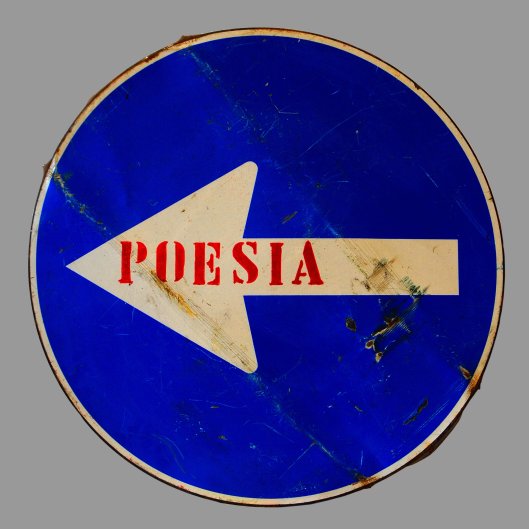
Lucia Marcucci – Poesia (1965)

So erscheinen die Bild- und Toncollagen dieser ersten Aufführung von Poesie e no als Hommage an die dadaistisch-futuristische Tradition und ihre Auseinandersetzung mit Sprache durch den Gruppo ‘70 – ein in Florenz gegründetes Künstler*innenkollektiv, dem Lucia Marcucci angehörte – und zugleich als Ausdruck der nicht-linearen Herangehensweise der Künstlerin selbst.

Die Erkundung des geschriebenen Wortes in seinen unterschiedlichen Ausformungen nimmt ihren Ausgang in einer kritischen, protestähnlichen Haltung, die sich mitunter betont militant gibt, stets aber ironisch und frei ist. Diese Merkmale inspirierten auch die von dem Grafikstudio Bruno aus Venedig besorgte Ausstellungsgestaltung.

Die im Piccolo Museion – Cubo Garutti zu sehenden Arbeiten Marcuccis ordnen sich hingegen in eine jüngere Werkphase ein. Sie zeigen ikonische Bilder der Kunstgeschichte, wie etwa Botticellis Venus oder Leonardos Mona Lisa, die auf große Leinwände gedruckt und durch malerische, mit ihrer Aneignung durch die Massenkultur spielende Interventionen erweitert wurden.

Parallel zu der Ausstellung im Museion präsentiert zudem die Ar/Ge Kunst in Bozen die von Francesca Verga und Zasha Colah kuratierte Schau L’Offesa.

Beide Einzelpräsentationen der Künstlerin kreisen um Erfahrungen, die zur Entstehung des Happenings Poesie e no geführt haben. Diese Reihe von Performance zeichnet sich durch eine collageartige Zusammenfügung visueller und sprachlicher Zeichen aus, die beide Einrichtungen nun zum Anlass nehmen, um komplementäre Stränge von Marcuccis Arbeit herauszustellen. Diese ist zum einen geprägt durch die im Museion thematisierte und in einer Kritik an der Konsumgesellschaft wurzelnde Untersuchung von Sprache und zum anderen durch die Gegenwart von Wort und Körper im Aktivismus, die in der Ar/Ge Kunst eine Neudeutung durch Stimmen der Gegenwart erfährt.

Aus Anlass der beiden Ausstellungen hat die Fakultät für Design und Künste der Freien Universität Bozen den Workshop für visuelle Kommunikation „Grafikdesign für Ausstellungen: Prozesse kultureller Praxis“ (Dozentin und Workshopleiterin Elisa Pasqual zusammen mit Gianluca Camillini und Gerhard Glüher) abgehalten. Hierbei wurden sieben Kommunikationsprojekte entwickelt, die Themen im Werk Lucia Marcuccis und des Gruppo ‘70 aus einer heutigen Perspektive aufgreifen. Die Workshop-Ausstellung wird am 9. Juni um 18 Uhr in der Freien Universität Bozen (Universitätsplatz 1) eröffnet und kann auch am Samstag, den 10. Juni, besucht werden.

Der Fokus auf Marcuccis Werk wird zudem ergänzt durch die Ausstellung Re-Materialisierung der Sprache in der Fondazione Antonio Dalle Nogare, in der auch einige Werke der Künstlerin zu sehen sind. In diesem Rahmen findet am 09.06. um 20 Uhr ein Vortrag der Künstlerin Nora Turato statt.

BEGLEITPROGRAMM:

– 13.07. 19.00 Uhr Führung in italienischer Sprache durch beide Ausstellungen gemeinsam mit den Kuratorinnen des Museion und der Ar/Ge Kunst

– 24.08. 17.00 – 19.00 Uhr Museion Ink – Session zum kreativen Schreiben: Anlässlich der Ausstellung Lucia Marcucci. Poseie e no unternimmt Museion Ink eine Reise ins experimentelle Schreiben und gibt den Teilnehmer*innen Gelegenheit, ihre Erfahrung der Welt festzuhalten.

Mit Roberta Pedrini. Anmeldung erforderlich unter eventbrite.it/museion oder 0471223435/13

Lucia Marcucci

Lucia Marcucci wurde 1933 in Florenz geboren, wo sie heute noch lebt und arbeitet. Gegen Ende der 1950er-Jahre begann sie, sich der Poesie unter Verwendung der Collagetechnik zu widmen. In den 1960er-Jahren wurde sie Mitglied des aus Eugenio Miccini, Luciano Ori, Lamberto Pignotti, Antonio Bueno bestehenden Gruppo ’70, dem sich bei einigen Projekten auch Antonio Bueno und Ketty La Rocca anschlossen. Unter Berücksichtigung der Beziehungszusammenhänge zwischen Wort und Bild benutzt Marcucci einen doppelten verbal-visuellen Code und erschafft ebenso provokative wie respektlose Werke. Häufig werden sie noch betont durch pointierte Botschaften aus der Terminologie von Comic-Sprechblasen, die die programmatische Linie des Gruppo ‘70 in origineller Weise variieren. Dieser löste sich Ende 1968 auf, und Lucia Marcucci begründete zusammen mit weiteren visuellen Dichter*innen den Gruppo Internazionale di Poesia Visiva. Daraufhin setzte sie ihre künstlerischen Experimente fort, entwickelte aber eigenständigere und unabhängigere Themen. In ihrem Schaffen der letzten Jahre bedient sich Marcucci der Collagetechnik ebenso wie digitaler Inhalte und Werbebilder und bearbeitet Plakate, die die städtischen Randbereiche tapezieren.

Museion Passage

In dem von einer multidisziplinären Arbeitsgruppe kuratierten Raum werden Werke aus der Museumssammlung kostenfrei und unabhängig von den laufenden Ausstellungen gezeigt. Ursprünglich war die Passage als Durchgang zwischen dem historischen und dem modernen Teil der Stadt konzipiert und nutzt diesen baulichen Aspekt nun als Metapher, um einen bewussten Dialog zwischen Generationen, Praktiker*innen und Gemeinschaften anzuregen. Die Museion Passage liest die Sammlung als ein Archiv unerzählter Geschichten und als Brücke zur Gegenwart. Daher wird die Auswahl der Werke bestimmt durch Themen und Ereignisse, die unsere aktive und vielfältige Kulturlandschaft heute beeinflussen.

Cubo Garutti

„In diesem kleinen Raum werden Werke aus dem Museum für moderne und zeitgenössische Kunst in Bozen ausgestellt, damit die Bewohner*innen dieses Stadtteils sie vor Ort sehen können. Der von der Autonomen Provinz Bozen – Südtirol – Italienische Kultur in Auftrag gegebene Raum ist all jenen gewidmet, die hier vorbeikommen und einen Blick darauf werfen, und sei es nur für einen Augenblick.“ Alberto Garutti.
Das im Jahr 2003 aufgestellte Piccolo Museion wurde von dem Künstler Alberto Garutti gestaltet und dient als Zweigstelle des Museion im Bozner Stadtviertel Don Bosco. Neben Werken aus der Museumssammlung werden in ihm auch eigens für den Stadtteil erarbeitete Projekte ausgestellt.
Der Cubo Garutti befindet sich in der Sassaristraße 17b – Bozen.

Kuratiert von Frida Carazzato

Direktor: Bart van der Heide

Verantwortliche Bereich Organisation Sammlung/Archiv: Elena Bini

Museion, Bozen 09.06.2023 –  03.09.2023

© Alle Rechte vorbehalten

Lucia Marcucci – Passione e miliardi (1966) – Collezione Museion, Archivio di Nuova Scrittura

Museion Passage – a freely accessible space dedicated to enhancing the museum’s collection and its links with the local territory – will host Poesie e no, an exhibition that marks the 90th birthday of Italy’s leading exponent of Visual Poetry, Lucia Marcucci. The artist’s work is included in the Archivio di Nuova Scrittura, a collection donated to Museion and the Mart museum by Paolo della Grazia in 2020.

The exhibition highlights Marcucci’s artistic research and experimentation in the 1960s and 1970s, through both her works and numerous theoretical and poetic writings. The works come from the Mart, the artist’s private archive, and from the Archivio di Nuova Scrittura part of the museum collection. Museion’s focus on this figure is part of its ongoing research into the works and artists in its collection: This includes underlining the contemporary nature of their art and the different artistic and interdisciplinary connections they create.

Marcucci’s works speak about post-World War II Italy. A society characterized by an economic boom, social and political reorganization and, towards the end of the 1960s, also by student protests and feminist movements. In this climate, many artists chose to express themselves in unconventional ways with new techniques and by creating a new definition of interdisciplinarity that can be seen in the artist’s works too.

The title of the exhibition, Poesie e no, derives from a poem-show of Lamberto Pignotti and Eugenio Miccini first presented in 1963 at the invitation of Lucia Marcucci, under the direction of Enrico Sirello. The presentation was then repeated several times in the following years, with the participation of the artis herself. The title, like the entire exhibition, is intended to emphasize how Marcucci’s artistic practice has always been characterized by the encounter between ‘high’ and ‘low’ culture and between literary language and everyday life expressed through the mass media. This is the reason for its tragic but ironic combination of text and image, painting and collage.

Lucia Marcucci – A,B,C,D,… (1973)

The visual and sound collage of the first performance of Poesie e no appears, on one hand, to be a tribute to the Dada and Futurist tradition of research into language, carried out by Gruppo 70 – an artistic collective established in Florence, of which Lucia Marcucci was a member – and on the other, an expression of the artist’s non-linear approach to art.

The exploration of written word in its various declinations starts from a critical, protest-like attitude that is sometimes markedly militant, but always ironic and free. These characteristics also inspire the exhibition layout, curated by the Bruno graphics studio in Venice.

The works by Marcucci exhibited at the Piccolo Museion – Cubo Garutti, on the other hand, are located in a temporal parenthesis closer to the present day. These are iconic images from the history of art, such as Botticelli’s Venus or Leonardo’s Mona Lisa, printed on large canvases enriched by pictorial interventions that play with the images and extend their expropriation by mass culture.

The Museion exhibition runs parallel to the exhibition L’Offesa at Ar/Ge Kunst, Bozen/Bolzano, curated by Francesca Verga and Zasha Colah.

The two solo shows gravitate around the experience that gave rise to the Poesie e no happening. The collage of visual and linguistic signs that characterizes this series of performances allows the two institutions to develop complementary strands of Marcucci’s work. On one hand, there is the investigation of language, starting with the critique of consumer society on display at Museion, and on the other, the presence of the verb and body in militancy, through an interpretation, featuring contemporary voices in the exhibition at Ar/Ge Kunst.

On the occasion of the two exhibitions, the Faculty of Design and Art at the Free University of Bozen-Bolzano held the visual communication workshop “Exhibition Graphic Design: processes of cultural practice” (lecturer and workshop leader Elisa Pasqual, with Gianluca Camillini and Gerhard Glüher). During the workshop, seven communication projects were developed that interpret themes present in the work of Lucia Marcucci and the ’70s Group through a contemporary perspective. The workshop exhibition will open on 9th June at 6 p.m. at the Free University of Bozen-Bolzano (University Square 1) and can also be visited on Saturday 10th June.

This focus on Marcucci’s work is complemented by the exhibition Ri-Materialisation of Language at the Fondazione Antonio dalle Nogare, which hosts some of her works. On 09.06. at 20 there will be a talk by the artist Nora Turato inside this exhibition.

COLLATERAL PROGRAM:

– 13.07 h 7.00 pm guided tour in Italian of the two exhibitions with the curators of Museion and Ar/Ge Kunst. Subscription required on eventbrite.it/museion

– 24.08 h 5.00-7.00 pm Museion Ink – Creative writing session: To mark the exhibition Lucia Marcucci. Poseie e no, Museion Ink. is embarking on a journey into experimental writing to document the participants’ experience of the world.
With Roberta Pedrini. Subscription required on eventbrite.it/museion or 0471223435/13

Lucia Marcucci

Lucia Marcucci was born in 1933 in Florence, where she still lives and works today. Towards the end of the 1950s, she began to devote herself to poetry through the technique of collage. During the 1960s, she became part of the Gruppo ’70 composed of her, Eugenio Miccini, Luciano Ori, Lamberto Pignotti, and for some collaborations also of Antonio Bueno and Ketty La Rocca. The double verbal-visual code is used by Marcucci according to a cohesion between word and image with a provocative and desecrating result, often underlined by unscrupulous messages taken from the terminology of comic balloons, which constitute an original version of the programmatic lines of the Gruppo ’70. This disbanded at the end of 1968 and Lucia Marcucci, together with other visual poets, founded the Gruppo Internazionale di Poesia Visiva. From this moment on, she continued her artistic experimentation, developing more autonomous and independent themes. In the production of recent years, Marcucci uses the collage technique and digital as well as advertising images, manipulating the posters that paper the outskirts of cities.

Museion Passage

Passage is a space curated by a multidisciplinary working group that presents works from the museum collection, free of charge and independently of the other exhibitions on display. Originally conceived as a passage between the historic and modern parts of the city, Museion Passage uses this aspect of the building as a metaphor to prompt an informed dialogue between generations, practitioners and communities. The space sees the collection as an archive of unnarrated stories and bridges to the modern world. In fact, the topics and events that impact today’s active and multi-disciplinary cultural landscape will influence which works are selected.

Cubo Garutti

“In this small room, works from the Bolzano Museum of Modern and Contemporary Art will be exhibited so that the citizens of this district can see them. This work, desired by the Autonomous Province of Bolzano – Alto Adige Italian Culture, is dedicated to all those who pass by here, and stop to take a look, even for just a moment.” Alberto Garutti.
Built in 2003, Piccolo Museion is a work by the artist Alberto Garutti. It is a detached branch of Museion in Bolzano’s Don Bosco district, where every year, in addition to exhibiting works from Museion’s collection, it also hosts projects conceived specifically for the district.
The Garutti Cube is located in Via Sassari 17b – Bolzano.

Curated by Frida Carazzato

Director: Bart van der Heide

Head of organisation collection/archives: Elena Bini

Museion, Bolzano/Bozen 09.06.2023 –  03.09.2023

© All rights reserved

Lucia Marcucci. L’OFFESA

08 giovedì Giu 2023

Posted by Lucia Marcucci in Eventi

≈ Lascia un commento

Tag

Annamaria Ajmone, Ar/Ge Kunst, Arte Contemporanea, Contemporary Art, Elena Biserna, Francesca Verga, Frida Carazzato, Laura Agnusdei, Lucia Marcucci, Museion, Poesia Visiva, Visual Poetry, Wissal Houbabi, Zasha Colah

La mostra L’Offesa ad Ar/Ge Kunst rilegge alcuni lavori dell’artista Lucia Marcucci (Firenze, 1933), realizzati a partire dagli anni Sessanta, sul versante verbo-visuale della poesia auditiva, della cinepoesia e delle tecniche di montaggio non-lineari, anche attraverso il contributo di alcune voci contemporanee (Wissal Houbabi, Elena Biserna e Annamaria Ajmone con Laura Agnusdei). 

Nel 1964 Lucia Marcucci crea il lavoro Il fidanzato in fuga, un collage su cartoncino che raffigura tre tute spaziali che si reggono in piedi da sole, come agganciate a dei manichini, senza corpo. Il collage recita: Paradiso extraterrestre della donna, il fidanzato in fuga nello spazio. Una frase ironica e provocatoria che denuncia la condizione della donna contemporanea e porta avanti la sua esigenza di libertà e trasgressione, all’interno di una società ossessionata dai progressi scientifici e tecnologici e a quel tempo in costante ascesa verso la “conquista” dello spazio. L’anno seguente, Lucia Marcucci, come parte del Gruppo ’70, con Eugenio Miccini, Lamberto Pignotti e Antonio Bueno, affigge manifesti per poi strapparli, come il manifesto L’Offesa, durante le loro poesie-spettacolo Poesie e no (1964-1967). Si tratta di una serie di happening multimediali contenenti poesie e materiali di matrice extra-letteraria. Questi eventi, in particolare Poesie e no 3 (1965), coinvolgevano diversi linguaggi: letture di poesie, rubriche giornalistiche, slogan, estratti di romanzi, proiezione di film sperimentali, e altre azioni effimere e volatili sotto le musiche di Giuseppe Chiari. Il tutto assemblato in un collage cubista di parole e recite, spezzoni, ritagli, scarti e rifiuti, che si allontana da una costruzione lineare dei contenuti.

Lucia Marcucci – Il fidanzato in fuga (1964)

Lucia Marcucci si è distinta per il rovesciamento della parola poetica, che è diventata parte delle lotte femministe negli anni Sessanta. Quello che l’artista definisce come “rispedire il lessico al mittente” significa portare avanti, attraverso l’apporto di ironia nel linguaggio, un riscatto critico sugli stereotipi, sul genere e gli assunti che regolavano la rappresentazione del corpo femminile, sulle forme e abitudini imposte dalla società capitalistica. L’opera di Lucia Marcucci riporta la parola nelle strade, nelle piazze, nelle vie e nei luoghi dove si svolgeva la relazione civica, e con essa i corpi. 

Per il novantesimo compleanno dell’artista, la mostra L’Offesa ad Ar/Ge Kunst ripercorre alcuni lavori di Marcucci realizzati tra gli anni Sessanta e gli anni Novanta in prestito dall’Archivio di Lucia Marcucci e dalla Galleria Frittelli Arte Contemporanea. La mostra affronta come la parola, la pubblicità, i media e la carta sono state messe in discussione negli anni Sessanta e Settanta attraverso una pratica militante che intensifica la presenza verbale e corporale.

La mostra L’Offesa ad Ar/Ge Kunst sviluppa inoltre una riflessione critica sulla contemporaneità mettendo alcune opere di Lucia Marcucci in dialogo con le voci di altre artiste. L’artista Wissal Houbabi porta un lavoro audio visuale e installativo nello spazio del dissenso e delle lotte antirazziali dell’attuale società; Elena Biserna con le score The Resounding Flâneuse e la passeggiata Feminist Steps (9-10 giugno 2023, Bolzano), esplora le esperienze (uditive) della città notturna da una prospettiva di genere; all’interno di Bolzano Danza, la danzatrice Annamaria Ajmone e la musicista Laura Agnusdei presentano Bleah!!! (20-21 luglio 2023, Parco dei Cappuccini, Bolzano) una partitura che mescola gesto e suono lavorando su assemblaggi e ribaltamenti sul piano temporale, spaziale, autoriale. In questa occasione, vengono pubblicati alcuni testi inediti di Lucia Marcucci nella serie di pubblicazioni di Ar/Ge Kunst Novellas. 

Lucia Marcucci, Bleah!!! (1967)

La mostra ad Ar/Ge Kunst si completa con la mostra Lucia Marcucci, Poesie e no presso Museion, Bozen/Bolzano, curata da Frida Carazzato. Le due personali gravitano intorno all’esperienza che ha dato vita all’happening di Poesie e no. Il collage di segni visivi e linguistici che caratterizza questa serie di performance permette alle due istituzioni di sviluppare due filoni complementari del lavoro di Marcucci: da una parte l’indagine sul linguaggio a partire dalla critica alla società dei consumi che trova spazio a Museion, dall’altra la presenza del verbo e corpo nella militanza, attraverso una lettura attuata anche da voci contemporanee nella mostra ad Ar/Ge Kunst.


Lucia Marcucci – Io sarò, qui, poeta (1995)

In occasione delle due mostre, il laboratorio di comunicazione visiva (Exhibition Graphic Design: processes of cultural practice) della Facoltà di Design e Arti della Free Università di Bozen-Bolzano (docente e workshop leader Elisa Pasqual, con Gianluca Camillini e Gerhard Gluher), ha sviluppato sette progetti di comunicazione che espandono in chiave contemporanea temi presenti nel lavoro di Lucia Marcucci e del Gruppo ‘70. La mostra del laboratorio inaugurerà il 9 giugno alle 18:00 alla Free Università di Bozen-Bolzano.

A completamento del lavoro di Marcucci, si segnala inoltre la mostra Ri-Materializzazione del Linguaggio presso la Fondazione Antonio dalle Nogare, Bolzano, che ospita delle sue opere. Il giorno 09.06. alle ore 20.00 si svolge inoltre un talk dell’artista Nora Turato a conclusione di questa mostra.

A cura di Francesca Verga e Zasha Colah 

Ar/Ge Kunst, Bolzano/Bozen, 09.06.2023 – 29.07.2023

PROGRAMMA:

  • 09.06 ore 18:30 inaugurazione mostra Lucia Marcucci, L’Offesa ad Ar/Ge Kunst
  • 09.06 e 10.06 ore 21:00 performance Elena Biserna, Feminist Steps (massimo 15 persone, su appuntamento: info@argekunst.it ) ad Ar/Ge Kunst
  • 13.07 ore 19:00 visita guidata dialogica delle curatrici Museion e Ar/Ge Kunst
  • 20.07 e 21.07 ore 20:00 performance di Annamaria Ajmone e Laura Agnusdei per Bolzano Danza (Parco dei Cappuccini, Bolzano)
  • 21.07 ore 17:00 talk con Annamaria Ajmone e Laura Agnusdei, con visita guidata alla mostra 

© Riproduzione riservata

Lucia Marcucci. POESIE E NO

08 giovedì Giu 2023

Posted by Lucia Marcucci in Comunicazioni

≈ Lascia un commento

Tag

Ar/Ge Kunst, Arte Contemporanea, Bart van der Heide, Contemporary Art, Elena Bini, Enrico Sirello, Eugenio Miccini, Fondazione Antonio Dalle Nogare, Francesca Verga, Frida Carazzato, Gruppo '70, Lamberto Pignotti, Lucia Marcucci, Mart, Museion, Paolo della Grazia, Poesia Visiva, Visual Poetry, Zasha Colah

A Museion Passage – spazio dedicato alla valorizzazione della collezione museale e al legame con il territorio, accessibile gratuitamente – inaugura la mostra dedicata a una delle maggiori esponenti italiane della Poesia Visiva, Lucia Marcucci, in occasione del suo novantesimo compleanno. L’artista è parte dell’Archivio di Nuova Scrittura, collezione donata a Museion e al Mart da Paolo della Grazia nel 2020.

Numerosi scritti teorici e poetici danno voce alle ricerche e sperimentazioni artistiche degli anni Sessanta e Settanta di Lucia Marcucci. Le opere provengono dal Mart, dalla collezione privata dell’artista, e soprattutto dall’Archivio di Nuova Scrittura parte della collezione museale. Il focus che Museion desidera dedicarle si inserisce infatti all’interno di una costante ricerca che il museo dedica alla valorizzazione della propria collezione, ai e alle sue protagoniste, evidenziandone di volta in volta la contemporaneità delle ricerche e le diverse connessioni artistiche e interdisciplinari. 

Le opere di Marcucci parlano dell’Italia del secondo dopoguerra, caratterizzata dal boom economico, un riassetto sociale e politico, e, verso la fine degli anni Sessanta, anche da contestazioni studentesche e da movimenti femministi. In questo clima, molti artisti e artiste scelgono di esprimersi secondo mezzi non convenzionali, con nuove tecniche e puntando sull’interdisciplinarità, come emerge dalle opere dell’artista stessa.

Il titolo della mostra, Poesie e no, deriva da una poesia-spettacolo di Lamberto Pignotti ed Eugenio Miccini presentata in una prima versione nel 1963 su invito di Lucia Marcucci, con la regia di Enrico Sirello, e che ebbe negli anni successivi diverse presentazioni e la partecipazione dell’artista stessa. Il titolo, come tutta la mostra, vuole sottolineare come la pratica artistica di Marcucci sia sempre stata caratterizzata dall’incontro tra cultura “alta” e cultura “bassa”, tra linguaggio letterario e quotidiano espresso attraverso i mezzi di comunicazione di massa: un connubio tra testo e immagine, pittura e collage, tragicità e ironia.

Lucia Marcucci – Passione e miliardi (1966) – Collezione Museion, Archivio di Nuova Scrittura

Il collage visivo e sonoro della prima rappresentazione di Poesie e no appare da un lato come un innesto della ricerca sul linguaggio con la tradizione dada e futurista, attuata dal Gruppo ’70 – collettivo artistico nato a Firenze, di cui Lucia Marcucci è stata parte – e dall’altro come un’espressione dell’approccio non lineare dell’artista all’arte. 

L’esplorazione della parola nelle sue diverse declinazioni parte da un atteggiamento critico e contestatore, a volte marcatamente militante eppure, sempre ironico e libero. Queste caratteristiche hanno ispirato anche il display della mostra, curato dallo studio grafico Bruno di Venezia.

Si collocano invece in una parentesi temporale più vicina ai giorni nostri, le opere di Marcucci esposte al Piccolo Museion – Cubo Garutti. Si tratta di immagini iconiche della storia dell’arte, come per esempio la Venere di Botticelli o la Monna Lisa di Leonardo, stampate su grandi tele arricchite da interventi pittorici che giocano con queste immagini, ampliando la loro espropriazione da parte della cultura di massa. 

Lucia Marcucci – Sex (2010)

L’esposizione di Museion si completa con la mostra L’Offesa presso Ar/Ge Kunst, Bozen/Bolzano, curata da Francesca Verga e Zasha Colah. 

Le due personali gravitano intorno all’esperienza che ha dato vita all’happening di Poesie e no. Il collage di segni visivi e linguistici che caratterizza questa serie di performance permette alle due istituzioni di sviluppare filoni complementari del lavoro di Marcucci: da una parte l’indagine sul linguaggio a partire dalla critica alla società dei consumi che trova spazio a Museion, dall’altra la presenza del verbo e corpo nella militanza, attraverso una lettura attuata anche da voci contemporanee nella mostra ad Ar/Ge Kunst.

In occasione delle due mostre, il laboratorio di comunicazione visiva (Exhibition Graphic Design: processes of cultural practice) della Facoltà di Design e Arti della Libera Università di Bozen-Bolzano (docente e workshop leader Elisa Pasqual, con Gianluca Camillini e Gerhard Glüher), ha sviluppato sette progetti di comunicazione che espandono in chiave contemporanea temi presenti nel lavoro di Lucia Marcucci e del Gruppo ‘70. La mostra del laboratorio inaugurerà il 9 giugno alle 18:00 alla Libera Università di Bozen-Bolzano (piazza Università 1) e sarà visitabile anche sabato 10 giugno.

A completamento del lavoro di Marcucci, si segnala inoltre la mostra Ri-Materializzazione del Linguaggio presso la Fondazione Antonio dalle Nogare, Bolzano, che ospita delle sue opere. Il giorno 09.06. alle ore 20:00 si svolge inoltre un talk dell’artista Nora Turato a conclusione di questa mostra.

PROGRAMMA COLLATERALE:

  • 13.07 h 19:00 visita guidata dialogica in italiano alle due mostre con le curatrici di Museion e Ar/Ge Kunst. Iscrizione richiesta su eventbrite.it/museion
  • 24.08 h 17:00-19:00 Museion Ink – Workshop di scrittura creativa in omaggio alla mostra Lucia Marcucci. Poesie e no. Un viaggio nella scrittura sperimentale per documentare in maniera poetica la visione del mondo dei partecipanti. Con Roberta Pedrini. È necessaria l’iscrizione su eventbrite.it/museion o telefonando allo 0471223435/13

Museion Passage

Passage è uno spazio curato da un gruppo di lavoro multidisciplinare dedicato alla presentazione di opere della collezione del museo, accessibili al pubblico gratuitamente e indipendentemente dalle mostre in corso. Concepito dagli architetti come passaggio tra la parte storica e quella moderna della città, Museion Passage utilizza questo aspetto dell’edificio come metafora per stimolare un dialogo consapevole tra generazioni, vari settori di attività e la comunità. Lo spazio guarda alla collezione come repertorio di storie non raccontate e ponte verso l’attualità. La selezione delle opere è guidata da temi ed eventi del paesaggio culturale odierno, attivo e interdisciplinare.

Cubo Garutti

“In questa piccola stanza saranno esposte opere del museo d’arte moderna e contemporanea di Bolzano per far sì che i cittadini di questo quartiere le possano vedere. Questa opera voluta dalla Provincia Autonoma di Bolzano – Alto Adige cultura italiana, è dedicata a tutti quelli che passando di qui, anche per un solo istante, la guarderanno”. Alberto Garutti

Realizzato nel 2003, il Piccolo Museion è un’opera dell’artista Alberto Garutti. Si tratta di una sede distaccata di Museion nel quartiere Don Bosco di Bolzano dove ogni anno oltre a esporre opere provenienti dalla collezione di Museion, sono ospitati anche progetti concepiti espressamente per il quartiere.

A cura di Frida Carazzato

Direttore: Bart van der Heide

Responsabile organizzazione collezione/archivio: Elena Bini

Museion, Bolzano/Bozen 09.06.2023 –  03.09.2023

© Riproduzione riservata

Post it

06 martedì Giu 2023

Posted by Lucia Marcucci in Eventi

≈ Lascia un commento

Tag

Alessandra Tortosa, Ar/Ge Kunst, Arte Contemporanea, Contemporary Art, Elisa Pasqual, Francesca Verga, Frida Carazzato, Lucia Marcucci, Museion, Poesia Visiva, Visual Poetry, Wissal Houbabi, Zasha Colah

Programma di Alessandra Tortosa che tratta temi storico, artistici e di costume dell’Alto Adige. Analizza i diversi aspetti culturali del nostro territorio e ne racconta la storia. Avvalendosi anche di musiche di autori locali propone itinerari naturalistici e artistici, infine presenta piccoli “tesori” dell’archivio Rai. | Rai Alto Adige Südtirol | Bolzano | 2023

Lucia Marcucci – Poesia (1965)

Due mostre dedicate a Lucia Marcucci, una delle maggiori esponenti italiane della Poesia Visiva, in occasione del suo novantesimo compleanno: al Museion e ad Ar/Ge Kunst; saranno presenti le curatrici Frida Carazzato, Francesca Verga e Zasha Colah, l’artista Wissal Houbabi e la docente della Lub Elisa Pasqual.

Lucia Marcucci – Bleah!!! (1967)

© Riproduzione riservata

Ricerca

Lucia Marcucci – Poesia Visiva

La mia poetica consiste, attraverso la parola e il segno, nella rielaborazione letteraria e pittorica, ma soprattutto critica, dei mass media (immagini, slogans, linguaggi variamente persuasori e mistificatori del sistema sociale contemporaneo).

My poetics consists, through the word and the sign, in the literary and pictorial, but above all critical, reworking of the mass media (images, slogans, variously persuasive and mystifying languages ​​of the contemporary social system).

Ma poétique consiste, à travers le mot et le signe, dans le remaniement littéraire et pictural, mais surtout critique, des médias de masse (images, slogans, langages diversement persuasifs et mystifiants du système social contemporain).

Meine Poetik besteht mittels Wort und Zeichen aus der literarischen und bildnerischen, vor allem aber kritischen Aufarbeitung der Massenmedien (Bilder, Parolen, unterschiedlich überzeugende und mystifizierende Sprachen des zeitgenössischen Gesellschaftssystems).

  • Instagram

Blog su WordPress.com.

  • Abbonati Abbonato
    • LUCIA MARCUCCI
    • Unisciti ad altri 45 abbonati
    • Hai già un account WordPress.com? Accedi ora.
    • LUCIA MARCUCCI
    • Abbonati Abbonato
    • Registrati
    • Accedi
    • Segnala questo contenuto
    • Visualizza sito nel Reader
    • Gestisci gli abbonamenti
    • Riduci la barra
 

Caricamento commenti...