
Tag
Ar/Ge Kunst, Arte Contemporanea, Contemporary Art, Francesca Verga, Lucia Marcucci, Museion, Poesia Visiva, Visual Poetry, Zasha Colah
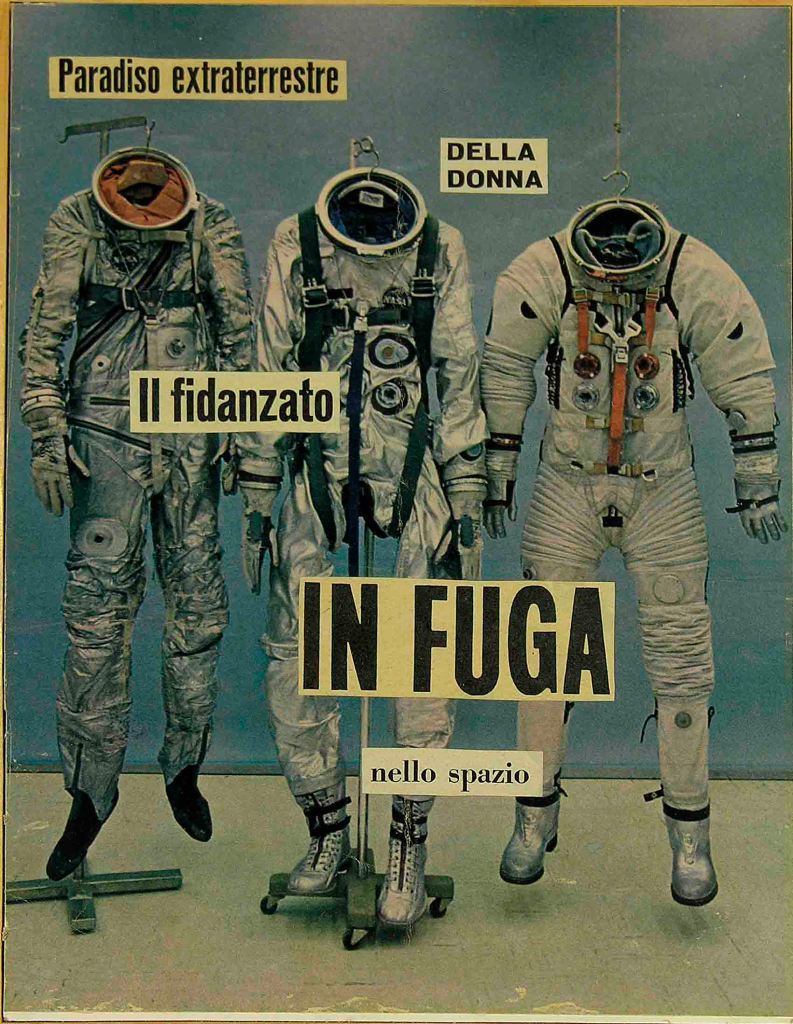
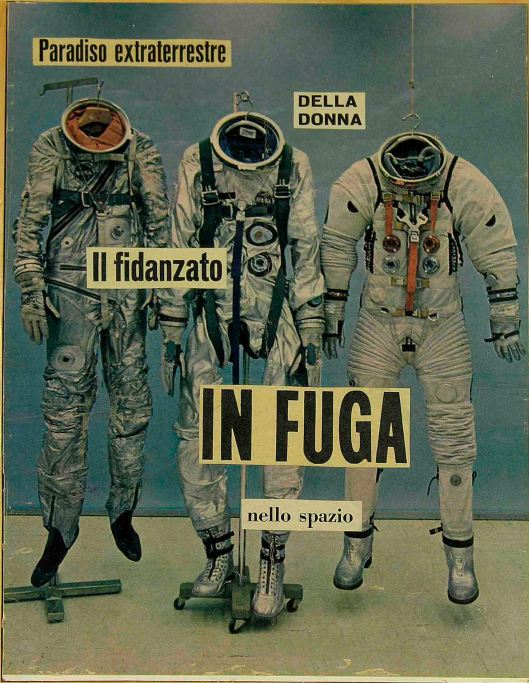
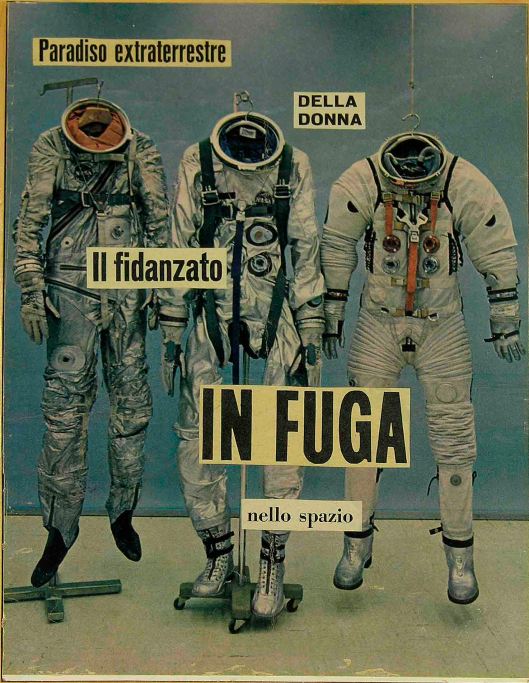
It was 1964 when artist Lucia Marcucci (Florence, 1933) created the work Il fidanzato in fuga: a collage on cardboard depicting three freestanding spacesuits, as if attached to clothes hangers, bodyless. The collage reads: “Paradiso extraterrestre della donna, il fidanzato in fuga nello spazio” (“A woman’s extra-terrestrial paradise: a fiance on the run in outerspace”). An ironic and provocatory phrase, it denounces the condition of contemporary women and showcases their need for freedom and transgression in a society obsessed with scientific and technological progress during the Cold War period, in constant ascent towards the ‘conquest’ of space. The following year, as part of Gruppo ’70, with Eugenio Miccini, Lamberto Pignotti and Antonio Bueno, Lucia Marcucci put up posters and then ripped them, including the poster L’Offesa, during their poetry shows Poesie e no (1964–1967). These were a series of multimedia happenings featuring poems as well as non-literary material. The events, particularly Poesie and no 3 (1965), drew on a range of languages—poetry readings, newspaper columns, slogans, extracts from novels, experimental film screenings and other ephemeral and volatile actions—to the music of Giuseppe Chiari. It was all put together in a Cubist-style collage of words and recitals, clips, scraps and offcuts, moving away from the linear construction of content.
Dorothy D. Lee (1905–1975) wrote about non-lineal thinking in the text ‘Lineal and Nonlineal Codifications of Reality’ (1950), which Marcucci would often quote.¹ In this text, the American anthropologist took the example of the interruption of the ‘thread of the discourse’ for people living in the Trobriand Islands, where it is accepted as something non-invasive in a culture characterised by the absence of linear continuity. Instead, the Western mindset that Marcucci challenges and criticises lulls itself into believing the line is the true path, that linear planning means success, increasingly thirsty for rectilinear progress. In this capitalist conception, there is no room left for failure as an interruption of linearly conceived movement. But is it so important to read reality through the presence of the line and reach a point on the horizon at a precise moment?
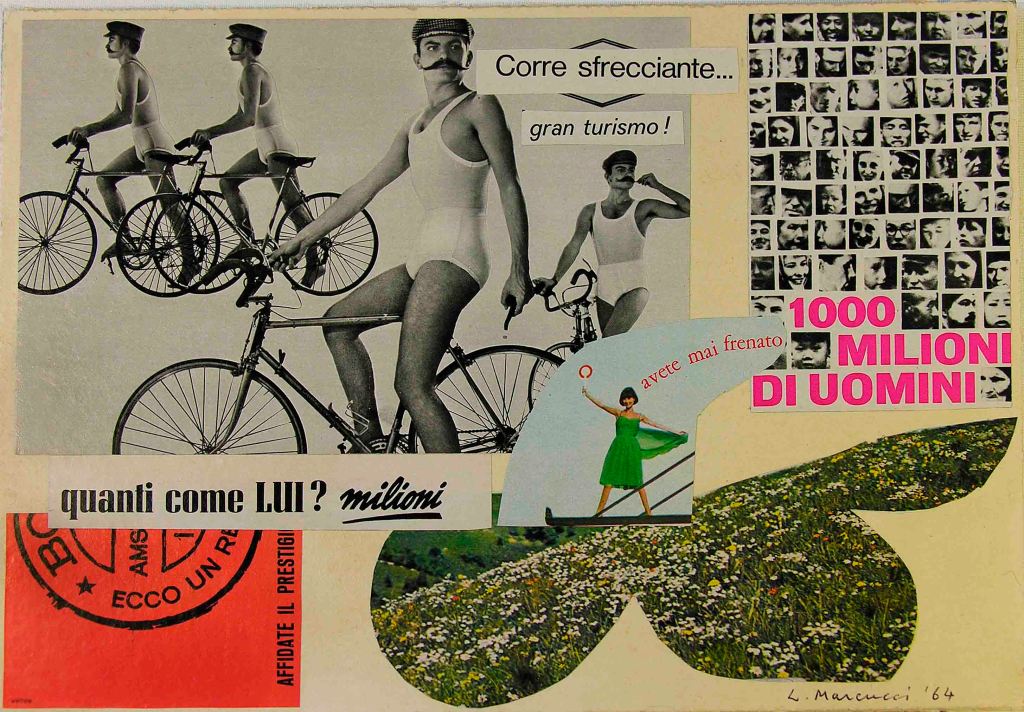
Lucia Marcucci seems to ask herself the same questions as Dorothy D. Lee, rooting her works along a pathway that is not a connection between two points but one that moves around, a source of continuous influences and obstacles, independent tracks, setbacks, failures and contestations. Her collages, like her works of cine-poetry, the non-linear montage technique—in particular Volerà nel ’70 (1965) and Pugni, Pistole e Baci (1966) —are reminiscent of many of Pedro Almodóvar’s films: a non-linear composition that steeps past and present in the narrative context. Dorothy D. Lee also referred to Trobriand verbs as timeless.² In these forms of conceiving, history and reality are always present, lending meaning to present actions. And this is how Marcucci plays it: rummaging through and drawing on her own past and that which surrounds us in the languages of mass communication, immersing us in a critical rereading of the present.
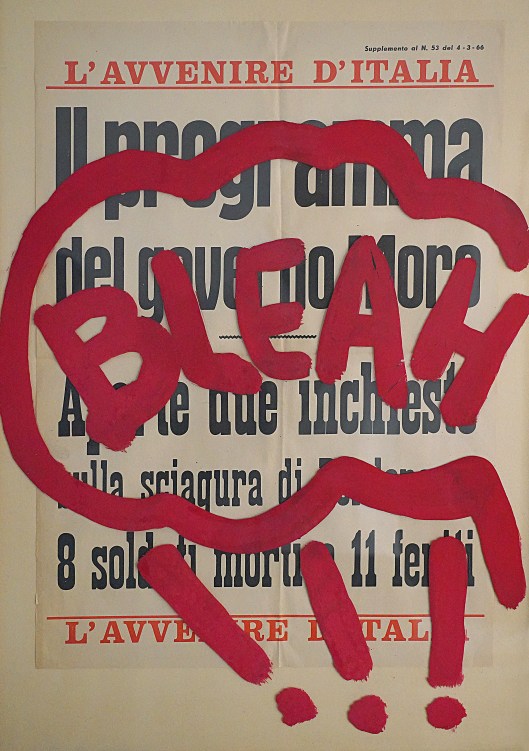
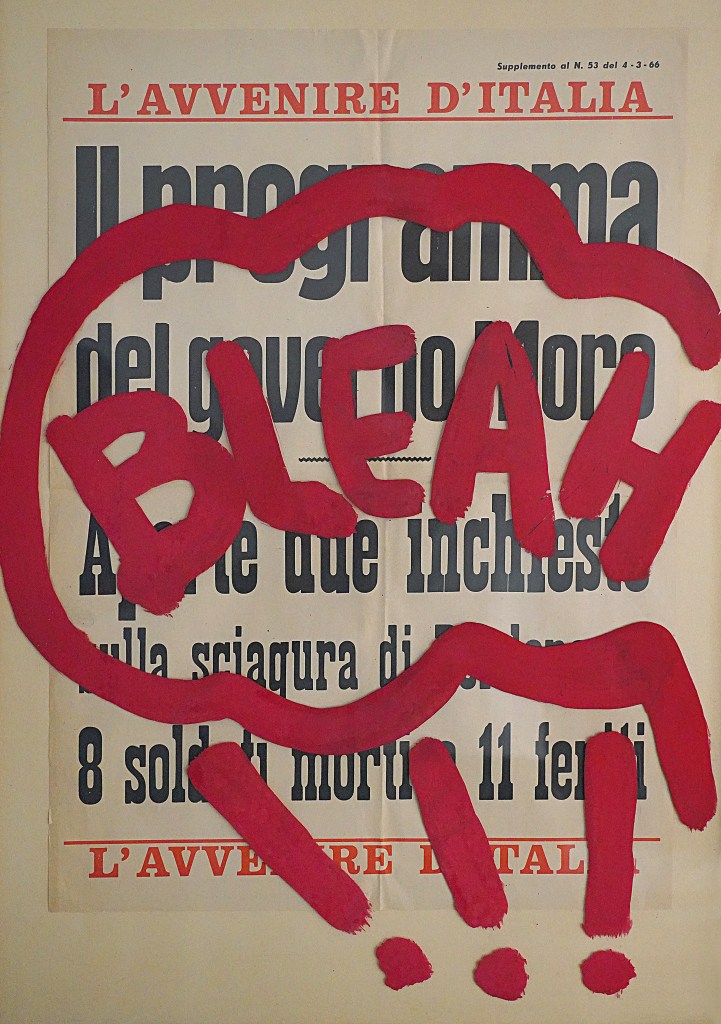
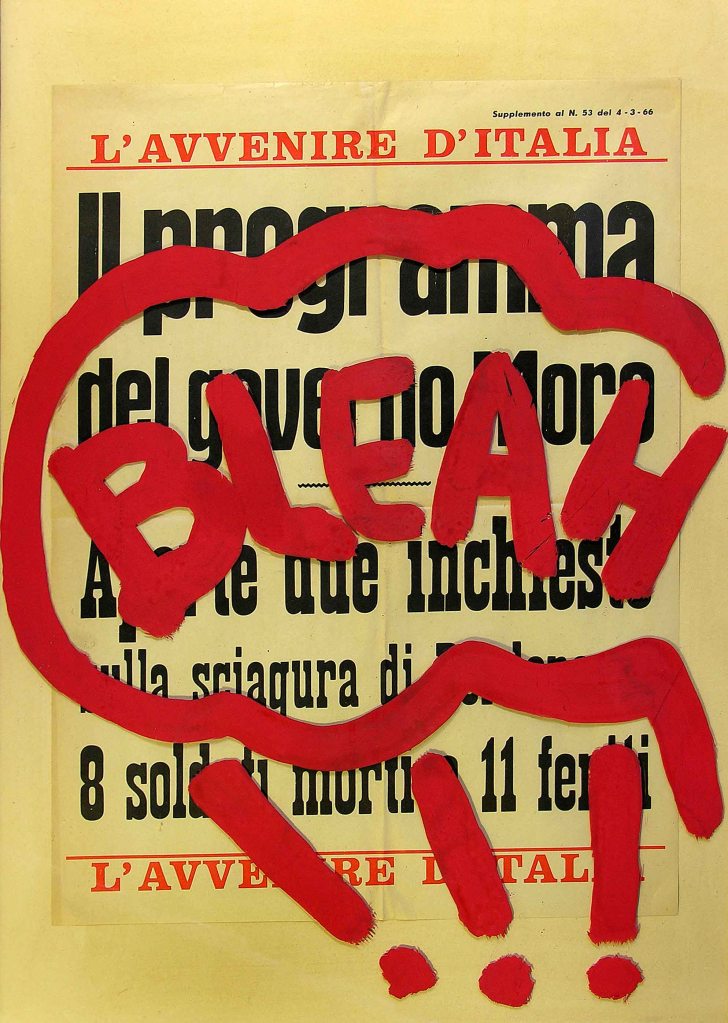
Lucia Marcucci stood out by virtue of her table-turning of the poetic word, which became part of the feminist struggles in the 1960s. What the artist defines as “returning the lexicon to the sender” means exploiting language with irony to pursue a critical redemption of stereotypes, of gender and the assumptions regulating representation of the female body, and of the forms and habits imposed upon it by capitalist society. The artist thus unveiled the nonsense and ideological emptiness underpinning mass communication, especially on topical issues. Bleah!!! (1967), a work on painted glass with a newspaper headline board, seemed to provide the only plausible answer at the time: one of outright dissent.
In 1965, Lamberto Pignotti published an anthology of visual poetry in the series Il Dissenso (published by Sampietro, Bologna). It consisted of four volumes featuring fragments of visual poetry, to be shuffled around like a pack of cards. From this moment on, the book form is extruded, exploding into the surrounding space and bringing the word to life beyond its container. There is no longer the word on paper but, like in Lucia Marcucci’s work, the word is brought back to the streets, squares and venues where civic relations might be established, and bodies along with them. But what role did (and does) the body—its perception, gesture and language—play within poetic struggle?
On the occasion of the artist’s ninetieth birthday, the exhibition L’Offesa at Ar/Ge Kunst (9 June – 29 July 2023), curated by Francesca Verga and Zasha Colah, retraces some of the artist’s works from the 1960s up to the 1990s on loan from the Lucia Marcucci Archive and the Frittelli Arte Contemporanea Gallery. The exhibition re-examines how speech, advertising, media and paper were questioned in the 1960s and 1970s through militant practices intensifying verbal and bodily presence. For it is through both body and word that the poetic worth of the stroke and its imaginative value may be rediscovered.
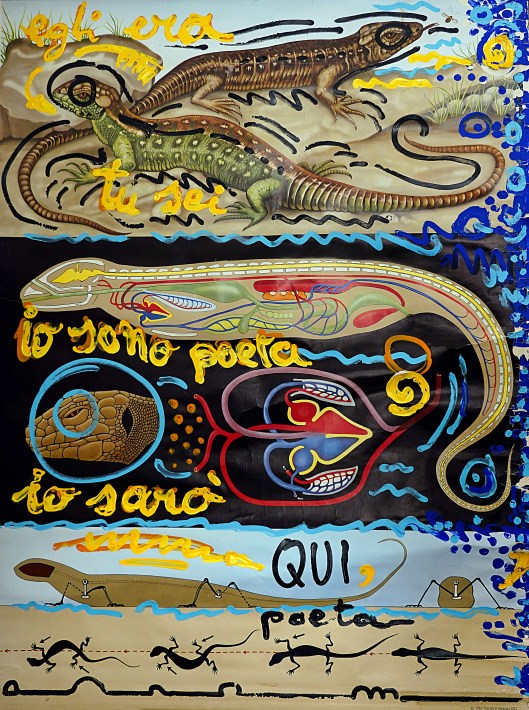
On display are a number of works created from the 1960s onwards on the verbo-visual side of technological poetry, auditory poetry, cine-poetry (such as the works Volerà nel ’70, 1965, and poesia auditiva, 1970), collages on cardboard and non-linear montage techniques. Together with these, the acrylics on prints and posters, such as Sigh (1968), Waah! (1968) and Boh, eh (1970), constitute a pivotal moment in the display of political and social dissent in poetic terms. Furthermore, there is also a return to the manual skills of the 1970s: the imprints of the artist’s body on emulsified canvases, along with the imprints, signs and words on her didactic tables produced in the 1990s reconfirm the artist’s interest in visceral dissections of the body and the link between body and word, continuing to toy with scientific contexts.
The exhibition L’Offesa at Ar/Ge Kunst also develops a critical reflection on the contemporary sphere by placing some of Lucia Marcucci’s works in dialogue with the voices of other artists. An audio-visual and installation work by the artist Wissal Houbabi brings dissent and struggles in today’s society in dialogue with Marcucci’s politics; Elena Biserna with the scores of The Resounding Flâneuse and the Feminist Steps walk (9–10 June 2023, Bolzano), explores the (auditory) experiences of the nocturnal city from a gendered perspective. And as part of Bolzano Danza, the dancer Annamaria Ajmone and the musician Laura Agnusdei present Bleah!!! (20–21 July 2023, Parco dei Cappuccini, Bolzano): a performance that blends gesture and sound in assemblages that are a table-turning of notions of the temporal, spatial and authorial.
The show at Ar/Ge Kunst is further complemented by the exhibition Lucia Marcucci. Poesie e no at Museion, Bolzano, curated by Frida Carazzato. The two solo shows revolve around the experience that gave rise to the Poesie e no happenings. The collage of visual and linguistic signs that characterises this series of performances allows the two institutions to explore two complementary strands of Marcucci’s work: on the one hand the investigation of language starting with the critique of consumer society that finds space in Museion, and on the other, the presence of the word and body in social militancy, through the interpretation further manifested by other contemporary voices in the Ar/Ge Kunst show.
Curatorial text by Francesca Verga and Zasha Colah, Ar/Ge Kunst, 2023.
Translation from Italian to English: Ben Bazalgette, 2023.
¹ Lee, Dorothy, „Lineal and Nonlineal Codifications of Reality“, in: Symbolic Anthropology: A Reader in the Study of Symbols and Meanings, hg. von Dolgin, Janet L., Kemnitzer, David S. und Schneider, David M., New York 1977, S. 151–164.
² Dorothy D. Lee, „Being and Value in a Primitive Culture“, in: dies., Freedom and Culture, Englewood Cliffs 1959, S. 89–104; „Codifications of Reality: Lineal and Nonlineal“, in: ebd. S. 105–120.
© All rights reserved
…
Es ist das Jahr 1964, und die Künstlerin Lucia Marcucci (*1933 in Florenz) gestaltet auf Karton die Collage Il fidanzato in fuga. Darauf dargestellt sind drei aufrecht stehende Raumanzüge, die aufgehängt sind wie Marionetten, aber ohne Körper. Collagiert ist zu lesen: „Das außerirdische Paradies der Frau, der Verlobte auf der Flucht ins All.“ Ein so ironischer wie provokanter Satz, der die Befindlichkeit der zeitgenössischen Frau spiegelt und ihren Anspruch auf Freiheit und Überschreitung in einer Gesellschaft betont, die besessen war von Wissenschaft, Technologie und Fortschritt und sich zur damaligen Zeit in einem kontinuierlichen Aufstieg hin zur „Eroberung“ des Weltraums wähnte. Im darauffolgenden Jahr hängte Lucia Marcucci – als Teil des Gruppo ’70 – zusammen mit Eugenio Miccini, Lamberto Pignotti und Antonio Bueno Plakate auf, nur um sie anschließend zu zerreißen, so geschehen etwa mit der Arbeit L’Offesa im Zuge ihrer gemeinsam aufgeführten Poesie-Spektakel Poesie e no (1964–1967). Dabei handelte es sich um eine Reihe multimedialer Happenings unter Einbeziehung von Gedichten sowie Matrixmaterialien außerliterarischer Herkunft. Im Rahmen dieser Veranstaltungen, allen voran Poesie e no 3 (1965), verbanden sich verschiedene Formen von Sprache: das Vorlesen von Gedichten, Zeitungskolumnen, Slogans und Romanauszügen mit der Vorführung experimenteller Filme und weiteren ebenso flüchtigen wie vergänglichen Aktionen zur Musikbegleitung Giuseppe Chiaris. Dies alles fügte sich zu einer aus Wörtern und Rezitationen, Ausschnitten, Fragmenten, Schnipseln und Überbleibseln gefügten Collage, die sich von einer linearen Konstruktion der Inhalte entfernte.
Über das nicht-lineare Denken hatte sich bereits Dorothy D. Lee (1905–1975) in dem von Marcucci gern zitierten Text „Lineare und nicht-lineare Kodifizierungen der Realität“ (1977) geäußert.¹ Darin führte die amerikanische Anthropologin die Bewohner*innen der Trobriand-Inseln als Beispiel für eine Kultur an, die durch das Fehlen von linearer Kontinuität geprägt ist und somit eine Unterbrechung des „Diskursfadens“ als nicht störend empfindet. Das von Marcucci infrage gestellte und kritisierte westliche Denken hingegen gibt sich der Illusion hin, dass die Linie unser Weg wäre und lineare Planung der Weg zum Erfolg, angetrieben von einem immer unersättlicheren Bedürfnis nach geradlinigem Fortschritt. In dieser kapitalistischen Vorstellungswelt bleibt kein Raum für das Scheitern, für die Unterbrechung einer als linear gedachten Bewegung. Ist es aber tatsächlich so wichtig, die Wirklichkeit über die Gegenwart der Linie zu lesen und zu einer bestimmten Zeit an einem bestimmten Ort am Horizont anzukommen?
Lucia Marcucci scheint sich die gleichen Fragen zu stellen wie Dorothy D. Lee, spürt in ihren Werken einer Spur nach, die keine Verbindung zwischen zwei Punkten darstellt, sondern in Bewegung ist, eine Quelle immer neuer Einflüsse sowie Ursache von Flecken, von eigenen Wegfindungen, Rückschritten, Fehlschlägen und Anfechtungen. Ihre Collagen erinnern ebenso wie ihre kinopoetischen Werke – vor allem Volerà nel ’70 (1965) und Pugni, Pistole e Baci (1966) – vielfach an die Filme Pedro Almodóvars, verknüpfen Vergangenes und Gegenwärtiges in einer Erzählung, die ohne Linearität auskommt. Schon Dorothy D. Lee hatte die trobriandischen Verben als zeitlos bezeichnet.² Folgt man diesen Vorstellungen, so sind Geschichte und Wirklichkeit stets gegenwärtig und geben unserem aktuellen Handeln einen Sinn ein. Und damit spielt Marcucci: Sie durchstöbert die eigene Vergangenheit, schneidet sich durch das, was uns die Sprachformen der Massenkommunikation zur Verfügung stellen, und lässt uns in eine kritische neue Lesart der Gegenwart eintauchen.
Ihr Werk zeichnet sich durch eine Umkehrung des poetischen Wortes aus, die auch Eingang in die feministischen Kämpfe der 1960er-Jahren fand. Wenn die Künstlerin davon spricht, „das Lexikon an den Absender zurückzusenden“, so bedeutet das, über einen ironischen und kritischen Gebrauch von Sprache eine Befreiung von Geschlechterstereotypen, von Annahmen über die Darstellung des weiblichen Körpers ebenso wie von aufoktroyierten Praktiken und Gewohnheiten der kapitalistischen Gesellschaft zu erreichen. Gerade in Bezug auf aktuelle Themen entlarvt Marcucci die sich hinter der Massenkommunikation auftuende Unsinnigkeit und ideologische Leere. Die Arbeit Bleah!!! (1967), bestehend aus bemaltem Glas und Zeitungsreklame, schien zur damaligen Zeit die einzig plausible Antwort zu geben: Dissens.
1965 veröffentlichte Lamberto Pignotti einen Sammelband visueller Poesie, der in der Reihe „Il Dissenso“ (Sampietro, Bologna) erschien. Die vier Bände beinhalten Fragmente visueller Poesie, die sich ähnlich wie Spielkarten mischen lassen. Ab diesem Moment dehnt sich das Buch aus, explodiert in den umgebenden Raum und lässt das Wort außerhalb seines Behälters lebendig werden. Somit steht das Wort nicht mehr nur auf dem Papier, sondern wird – wie auch im Werk Lucia Marcuccis – wieder auf Straßen und Plätze, in Leben und Orte gebracht, an denen Zivilbürgerschaft stattfindet, und mit ihr der Körper. Welche Rolle aber spielten (und spielen) der Körper und seine Wahrnehmung, die Geste und die Sprache im poetischen Kampf?
Anlässlich des 90. Geburtstags Lucia Marcuccis zeigt die Ar/Ge Kunst in der Ausstellung L’Offesa (9. Juni – 29. Juli 2023) verschiedene Werke der Künstlerin aus den 1960er- bis 1990er-Jahren, die von ihrem Archiv sowie der Galerie Frittelli Arte Contemporanea (Florenz) als Leihgaben zu Verfügung gestellt wurden. Die von Francesca Verga und Zasha Colah kuratierte Schau führt vor Augen, wie Sprache, Werbung, Medien und Papier in den 1960er- und 1970er-Jahren von einer militanten Praxis auf den Prüfstand gestellt wurden, die auf verbale und physische Gegenwart setzte. Anhand von Körper und Wort entdeckte sie die poetische Gültigkeit des Zeichens und seinen imaginativen Wert neu.
Gezeigt werden ab den 1960er-Jahren entstandene verbo-visueller Werke der technologischen und auditiven Poesie, Kinopoesien mit nicht-linearen Montagetechniken (etwa die Arbeiten Volerà nel ’70 von 1965 und Poesia auditiva von 1970) sowie Collagen auf Karton. Daneben bieten auch die Acrylübermalungen von Reklame sowie Plakate wie Sigh (1968), Waah! (1968), Boh, eh (1970) kardinale Beispiele für die Formulierung politischen und gesellschaftlichen Dissenses in einer poetischen Tonart. Ebenfalls thematisiert wird die Rückbesinnung der 1970er-Jahre auf eine manuell geprägte Herangehensweise, etwa in den eigenen Körperabdrücken der Künstlerin auf emulgierten Leinwänden. Auch die Gesten, Zeichen und Wörter auf Schautafeln der 1990er-Jahre bestätigen erneut Marcuccis Interesse an viszeralen Bereichen des Körpers und seiner Verbindung zum Wort sowie den spielerischen Umgang der Künstlerin mit wissenschaftlichen Kontexten.
Darüber hinaus unternimmt die Ausstellung L’Offesa eine kritische Reflexion aus zeitgenössischer Perspektive, indem sie einige Werke Lucia Marcuccis in einen Dialog mit den Stimmen anderer Künstler*innen stellt. So bringt etwa die Künstlerin Wissal Houbabi eine audiovisuelle Installation in den Raum des Dissenses und der antirassistischen Kämpfe unserer heutigen Gesellschaft ein; Elena Biserna erkundet mithilfe der Partituren The Resounding Flâneuse und dem Spaziergang Feminist Steps (9./10. Juni 2023, Bozen) die (Hör-)Erfahrungen der nächtlichen Stadt aus einer geschlechtsbezogenen Perspektive; und im Rahmen von Bolzano Danza zeigen die Tänzerin Annamaria Ajmone und die Musikerin Laura Agnusdei die Geste und Klang verbindende Partitur Bleah!!! (20./21. Juli 2023, Kapuzinerpark, Bozen), die mit Assemblagen und dem Durchbrechen zeitlicher, räumlicher wie auktorialer Zusammenhänge arbeitet.
Die Ausstellung in der Ar/Ge Kunst wird ergänzt durch die von Frida Carazzato kuratierte Schau Lucia Marcucci. Poesie e no im Museion in Bozen. Beide Einzelpräsentationen kreisen um Erfahrungen, die zur Entstehung des Happenings Poesie e no geführt haben. Die mehrfach aufgeführte Performance zeichnet sich durch eine collageartige Nebeneinanderstellung visueller und sprachlicher Zeichen aus und wird zum Anlass, um in beiden Einrichtungen jeweils komplementäre Stränge von Marcuccis Œuvre zu beleuchten: So findet die von einer Kritik an der Konsumgesellschaft ausgehende Untersuchung von Sprache ihren Raum im Museion, während die Gegenwart von Wort und Körper im Aktivismus eine Re-Lektüre auch durch zeitgenössische Stimmen in der Ar/Ge Kunst erfährt.
Kuratorischer Text, Francesca Verga und Zasha Colah, Ar/Ge Kunst, 2023.
übersetzt von Ursula Fethke
¹ Lee, Dorothy, „Lineal and Nonlineal Codifications of Reality“, in: Symbolic Anthropology: A Reader in the Study of Symbols and Meanings, hg. von Dolgin, Janet L., Kemnitzer, David S. und Schneider, David M., New York 1977, S. 151–164.
² Dorothy D. Lee, „Being and Value in a Primitive Culture“, in: dies., Freedom and Culture, Englewood Cliffs 1959, S. 89–104; „Codifications of Reality: Lineal and Nonlineal“, in: ebd. S. 105–120.
© Alle Rechte vorbehalten




 LUCIA MARCUCCI